

Landlord End of Tenancy Cleaning Guide: Everything You Need to Know
End of tenancy cleaning (for a landlord) means ensuring the property is returned to the same standard of cleanliness it was in at move-in, then verifying it at checkout. If the tenant does not meet that standard, you can arrange cleaning and (where justified) claim the reasonable cost from the deposit, as long as your evidence is solid.
This guide is written for landlords who want fewer disputes, faster re-lets, and clean, defensible decisions. It covers what you can legally require, what a “professional standard” clean actually looks like in practice, what it costs, and what evidence wins when a tenant challenges a deduction.
Table of Contents
Landlord Quick Actions: The 5-Step Turnover Plan (Fast and Dispute-Proof)
If you only do five things, do these:
- Document: Ensure your move-in inventory is signed and contains dated, high-resolution photos.
- Communicate: Offer a walkthrough 30 days before checkout to highlight problem areas.
- Inspect: Conduct the final checkout inspection the day the keys are returned.
- Evidence: Collect a minimum evidence pack: photos, invoices, and itemised costs.
- Resolve: Discuss deductions early to avoid formal adjudication.
Why End of Tenancy Cleaning Matters?
Here’s a number worth sitting with: Cleaning comes up in around 54% of formal deposit dispute cases. Not damage. Not unpaid rent. Cleaning.
According to data from the Tenancy Deposit Scheme (TDS), it’s the single biggest reason landlords and tenants end up in adjudication. And yet it’s also one of the most preventable problems, because, unlike accidental damage, cleanliness is something both parties can agree on, document, and verify if they go about it the right way.
For landlords specifically, the stakes are real. Some industry reports put average deposits around £1,175. A property that sits empty for two weeks because it’s not in a rentable state after a tenancy ends costs more than most professional cleans. For a flat renting at £1,500 a month, just 14 days of vacancy costs roughly £700 in lost income, more than the price of even a thorough deep clean.
Keeping a property clean between tenancies isn’t just a hygiene issue. It’s a financial one.
The ROI of Turnover: Why ‘Clean’ is a Financial Strategy
Experienced landlords view cleaning not as a final chore, but as a strategic investment in asset value. The financial logic is simple: a property that sits vacant due to poor presentation is a leaking revenue stream.
In 2026, the average UK rent reached record levels, meaning even a short void period is more expensive than a top-tier professional clean. You can calculate your potential loss using this formula:
$$Loss = \frac{Monthly Rent}{30} \times Days Vacant$$
For a property renting at £1,800 per month, a 14-day vacancy costs you £840 in lost income, far exceeding the typical £250–£350 cost of a deep turnover clean. Furthermore, a pristine property justifies premium rent and attracts higher-quality tenants who are statistically more likely to treat the property well, reducing long-term maintenance costs.
Tenant message you can copy (send 30 days before checkout)
Hi [Name], as your move-out date approaches, here’s what we’ll be checking at checkout. The property needs to be returned to the same cleanliness standard as at move-in (allowing for fair wear and tear).
Please pay extra attention to:
- Oven, hob, extractor filters, and inside cupboards/drawers
- Bathroom limescale (taps, shower screen), grout, and silicone seals
- Skirting boards, door frames (especially tops), switches/handles
- Window glass (inside), sills, and tracks
- Behind/under movable appliances (where safe)
If you’d like, we can do a quick pre-checkout walkthrough about 30 days before you leave to flag anything early. Also, please take dated photos once cleaning is finished.
Thanks,
[Your Name]
This sets expectations early, reduces surprises at checkout, and gives you a clean communication log if there’s a dispute.
What the law really allows (and what it does not)
You cannot force a tenant to pay for professional cleaning or demand a receipt as a condition of ending the tenancy. What you can require is that they return the property to the same cleanliness standard it had at the start of the tenancy.
That difference matters:
- If the place was professionally cleaned at move-in, and your inventory proves it, the tenant must return it to that same standard.
- The tenant can clean it themselves or hire help. The method is their choice.
- If they fail, you may be able to claim the reasonable cost of bringing it back to the documented baseline.
This only works if your evidence is good. Without a clear check-in baseline, “it wasn’t clean” is just vibes, and adjudicators do not award deposits based on vibes.
Landlords who ignore these rules should know that the local authorities can enforce penalties for prohibited fees, and the amounts depend on the breach and whether it’s a repeat offence.
Renters’ Rights Act changes from 1 May 2026
From 1 May 2026, many tenancies move toward periodic arrangements, which can make turnover planning more frequent and less predictable. That makes clear cleaning standards and solid evidence even more important, especially where pets or hygiene issues are involved.
Why Landlords Sometimes Get This Wrong and Why It Costs Them
A lot of the complaints you see on forums like Reddit’s r/TenantsInTheUK come down to letting agents overstepping, demanding professional cleaning receipts, charging excessive amounts for basic tasks, or using vague language in tenancy agreements that doesn’t hold up legally. Tenants are increasingly aware of their rights, and many will challenge unfair deductions through the TDS adjudication process.
The problem for landlords isn’t usually bad intent; it’s a lack of clarity about what they can and can’t do. An agent tells them, “We always require a professional clean receipt.” They repeat that requirement, and suddenly they’re in a dispute over something that could have been avoided entirely.
The cleaner path in every sense is to be upfront with tenants from day one, conduct a thorough move-in inventory, and let the standard speak for itself at the end.
Move-in vs move-out: the standard that decides everything
The deposit decision usually comes down to one question: “Does move-out match move-in, allowing for fair wear and tear?” Cleanliness is not wear and tear.
A few plain examples:
- Worn carpet pile after years of normal use = wear and tear
- Grease in the oven and carbon build-up = cleaning failure
- Dusty skirting boards = cleaning issue, not wear and tear
- Limescale on taps = cleaning issue, especially if the property was limescale-free at move-in
If you want deductions to stick, your move-in inventory should be separate:
- condition (not broken, not torn, not cracked)
- cleanliness (dust-free, grease-free, limescale-free, stain-free)
“Good condition” alone is not a cleanliness standard. It’s too vague, and it backfires.
The TDS Principle: Condition is Not Cleanliness
One of the most common ways landlords lose deposit disputes is by using vague language in their inventory. A core TDS principle is that “good condition” refers to the physical state of an item (e.g., “the sofa isn’t torn”), whereas “cleanliness” refers to hygiene (e.g., “the sofa is free of stains”).
To protect your investment, your inventory should explicitly state the cleanliness standard using terms like “Professionally Cleaned” or “Domestic Standard”. If your report only says “good condition,” an adjudicator may rule that you haven’t established a baseline for cleanliness, making it nearly impossible to claim for a dirty property later.
Professional vs Domestic Standard:
A Professional Standard represents a level of deep cleaning typically achieved by specialized contractors (e.g. grease-free ovens and descaled taps). A Domestic Standard refers to regular household cleaning. If your check-in report states “domestically clean,” you cannot legally claim for a “professional clean” at checkout, as this would be considered betterment.
What “professional standard” cleaning actually means (the reality check)
A professional standard clean isn’t “looks fine at a glance.” It means the areas that fail checkouts are clean too. Inventory clerks don’t just look at the middle of the room. They check the boring places because those are the places most people skip.
The usual fail points that trigger deductions:
- oven racks, oven door glass, and behind knobs
- extractor filters and the greasy dust above wall cabinets
- fridge seals, drawers, and drainage channels
- shower screen film, grout lines, silicone seals, and toilet rim underside
- window runners and sills
- skirting boards, door frame tops, light switches, and radiator edges
If your page is going to rank and get cited, this is the kind of specificity that separates it from generic “clean the kitchen” advice.
End of Tenancy Kitchen Cleaning: The Highest-Risk Room
The kitchen is where most deposit deductions happen. Tenants often do a surface-level clean and miss the areas that matter most to a professional assessment.
What to check and clean:
- Oven interior, racks, and door glass. Any carbonised grease or burnt-on residue is a red flag. The oven needs to be restored to a smoke-free, grease-free state. This usually requires a specialist oven cleaner product or a professional oven cleaning service, as standard multi-surface sprays won’t cut through carbon buildup.
- Extractor fan and filters. These get overlooked constantly. Filters should be degreased thoroughly or replaced if they’re beyond cleaning.
- Tops of wall cabinets: Inventory clerks know to check here. A thick layer of grease and dust on top of wall units is a very common finding. It’s out of sight in daily life, which is exactly why it accumulates.
- Inside the fridge and freezer, on the rubber door seals, in the rear drainage channels, and under the salad drawer. Defrost the freezer at least 24 hours before handover so everything can be properly cleaned and dried.
- Sink and taps. Limescale around the tap base and underneath the spout is one of the most common findings in hard water areas.
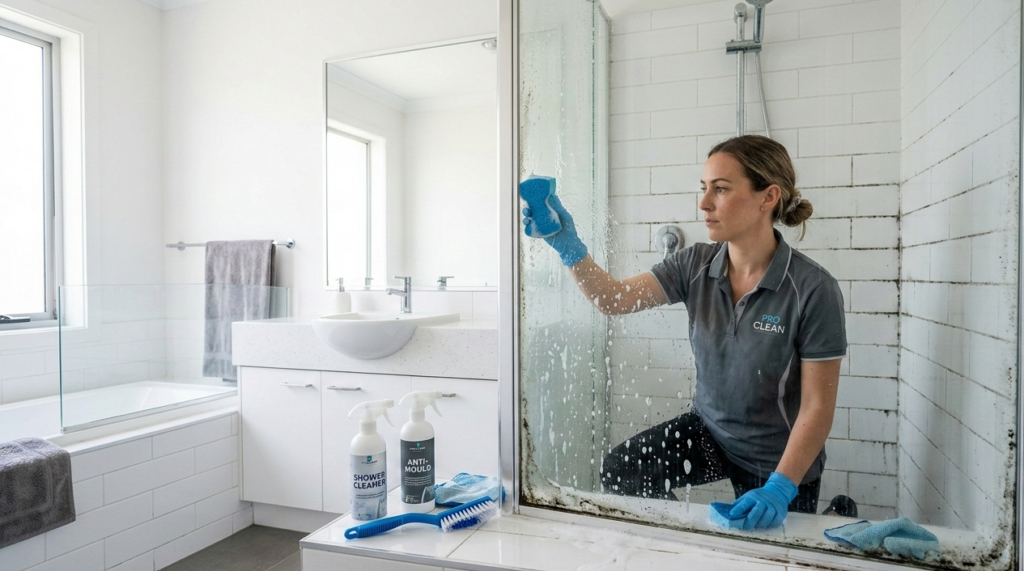
End of Tenancy Bathroom Cleaning: Limescale, Mould, and Seals
Hard water areas, which include London, Reading, and much of the South East, make bathroom cleaning significantly harder. Calcium deposits build up fast and need acidic cleaners (white vinegar or commercial descalers) to shift properly.
What to check and clean:
- Taps, showerheads, and tiles. All white calcium deposits need to be removed. This isn’t just aesthetic; adjudicators will note limescale as a cleaning failure.
- Grout lines and silicone seals. Mould growth here is one of the most contentious areas in deposit disputes. Regular anti-fungal treatment during the tenancy keeps this manageable, but by move-out, any visible mould in silicone or grout needs to be treated or re-sealed.
- Toilet (including the underside of the rim and behind the base). Areas that don’t get cleaned regularly and are always inspected.
- Shower screen or curtain. Hard water leaves a film on glass that needs a dedicated glass cleaner and a squeegee.
End of Tenancy Window, Skirting Board, and Woodwork Cleaning
These areas are where even reasonably thorough DIY cleans tend to fall short.
- Window tracks and sills. Internal glass is often wiped down, but the tracks collect dead flies, dust, and mould. A cotton bud or old toothbrush gets into the corners that a cloth misses.
- Skirting boards and tops of door frames. Professional inventory clerks sometimes use flash photography specifically because it shows up dust that’s invisible in normal light. A thin grey film on skirting boards is extremely common and very visible in photos.
- Curtain rails and light fittings both accumulate dust that settles and drifts over time.
End of Tenancy Cleaning Checklist: Room by Room
Use this as a practical reference for what should be covered in every room before a checkout inspection.
Kitchen
- Oven interior, racks, glass door, and oven surround
- Extractor fan and filter (clean or replace)
- Hob, burners, and surrounding surfaces
- Inside and outside of all cupboards and drawers
- Top of wall cabinets
- Fridge and freezer (defrosted, seals cleaned)
- Sink, taps, and surrounding tiles
- Floors (swept, mopped, edges and corners)
Bathroom
- Toilet (seat, bowl, rim, base, behind and underneath)
- Shower cubicle or bath (including screen or curtain)
- Taps and showerhead (descaled)
- Grout and silicone seals (mould-free)
- Mirror and any glass shelving
- Floor (including behind the toilet and under the sink unit)
All Rooms
- Dust all surfaces, shelves, and ledges
- Skirting boards and door frames (top and sides)
- Light switches and socket covers
- Window glass (inside), sills, and tracks
- Radiators (including behind, where possible)
- Floors (vacuum, then mop hard floors)
- Curtains or blinds (dust or wash as appropriate)
Throughout
- All walls (mark and scuff removal where possible)
- Loft hatch (if accessible, cleared and clean)
- Garden or outdoor area, if applicable (mowed, debris cleared)
How Much Does the End of Tenancy Cleaning Cost in the UK? (2025/2026 Prices)
Prices vary depending on property size, location, and how the property has been maintained. These are realistic ranges based on 2025/2026 market rates:
| Property Type | London (Zone 1–3) | Manchester / Leeds | Birmingham / Bristol | Scotland |
| Studio / 1 Bed | £150 – £250 | £120 – £180 | £130 – £190 | £110 – £160 |
| 2–3 Bed House | £300 – £590 | £240 – £450 | £260 – £470 | £220 – £400 |
| 4+ Bed House | £640+ | £550+ | £580+ | £500+ |
Note: Ranges vary by condition and what’s included (oven/carpets often extra).
London prices tend to be higher because of parking and congestion costs on top of labour costs. In rural or smaller towns, independent cleaners often come in at the lower end of or below these ranges.
What is usually extra?
While base quotes cover standard deep cleaning, certain tasks require specialist equipment and are often priced separately:
- Carpet Steam Cleaning: £25-£60 per room.
- Professional Oven Clean: £50-£120 depending on size.
- Upholstery/Mattress Cleaning: £20-£80 per item.
Landlord Labour vs Professional Invoices
If you decide to tackle the cleaning yourself to save on costs, be aware of the “Reasonable Expense” rule used by adjudicators. You generally cannot charge a tenant the same hourly rate as a commercial cleaning firm.
If a dispute reaches the TDS, you can usually only claim for materials and a “reasonable” hourly rate for your time, often benchmarked closer to the UK minimum wage rather than the £25-£30 per hour charged by agencies. Conversely, a professional invoice from a VAT-registered company is far more difficult for a tenant to dispute, as it represents a transparent, market-rate commercial cost.
A few things that affect cost are worth knowing:
- Oven cleaning is often quoted separately, typically £45–£80 per oven. Make sure it’s included in any quote you get, or you’ll be billed extra.
- Carpet cleaning may also be priced separately. A professional steam clean for a 2-bedroom flat typically runs £60–£120.
- Very dirty properties, particularly those where the tenant clearly hasn’t cleaned throughout the tenancy, will cost significantly more. Some companies charge hourly, which means a heavily neglected property could double the standard fixed-price quote.
Pre-checkout walkthrough: prevent disputes early
The checkout process is traditionally adversarial, but modern property management uses it as a relationship-building tool. Psychologically, tenants are more likely to put in effort to clean if they feel respected rather than judged.
Implement a “Soft Inspection” 30 days before the move-out date. Instead of a formal report, offer a collaborative walkthrough. Point out high-scrutiny areas, like the oven extractor or window runners, while the tenant still has time to rectify them. This transparency reduces anxiety and cuts down on cleaning-related disagreements. If you do need to claim, it also makes deductions easier to defend with evidence.
Tip: Start inspections at the entrance/hallway and kitchen because first impressions affect how strict the rest of the inspection feels.
Best Practices for Landlords at the End of Tenancy
Conduct a Thorough Move-In Inventory with Photographs
This is the single most important thing a landlord can do. Every room, every appliance, every surface photographed, dated, and ideally signed by the tenant within 48 hours of move-in. Digital inventory software like Kaptur or Reports2Go creates a time-stamped, tamper-proof record that holds up in adjudication far better than a paper form.
The inventory sets the standard. Without it, you have no legal basis for any deduction.
Streamlining with DigiSign and Kaptur
To eliminate the administrative burden of turnover, integrate digital tools like DigiSign or Kaptur. These platforms allow for an automated check-in service where tenants sign the inventory electronically.
Crucially, they send automated reminders if a tenant fails to sign. If they don’t respond within a set timeframe (usually 48 hours), the report can be “deemed accepted,” legally securing your move-in baseline without you having to manually chase the tenant.
Utility Tool: Notice of Intent to Inspect Template
Use this cooperative template to set the right tone 30 days before checkout. Focusing on the property rather than the tenant’s lifestyle prevents the process from feeling adversarial.
“Dear, as we approach the end of your tenancy, I’d like to offer a voluntary ‘pre-checkout’ walkthrough. The goal is to compare the property’s current state with our initial inventory and identify any areas (such as the oven or bathroom limescale) that may need attention. This gives you time to rectify these spots and ensures a smooth deposit return process for both of us.”
Offer a Pre-Move-Out Walkthrough
About 30 days before the tenancy ends, offer the tenant a voluntary walkthrough of the property. Point out anything that will need attention, such as an oven that hasn’t been cleaned since they moved in, carpet staining, or mould in the bathroom. This gives them time to fix it.
It sounds counterintuitive to help avoid a deduction? But it actually protects you. A tenant who knows what’s expected is far less likely to dispute a deduction later, because they had the chance to remedy it and either did or didn’t. It turns an adversarial process into a collaborative one, and 9 times out of 10, that means less hassle for everyone.
Use Eco-Friendly Cleaning Products Where Possible
This isn’t just about environmental responsibility, though that matters. Harsh chemical cleaners can damage natural stone floors, heritage wood, and heritage-painted surfaces in older properties. Using pH-neutral or enzyme-based cleaners protects surfaces and reduces long-term maintenance costs. Citrus enzyme degreasers work well in kitchens without damaging laminate or paint. Steam cleaning for carpets and upholstery kills bacteria and allergens without any chemical residue.
Budget Cleaning as a Standard Operating Cost
A useful rule of thumb: budget roughly 1% of the property’s market value per year for maintenance, which includes end of tenancy turnovers. For a £400,000 property, that’s £4,000 a year. Factoring in professional cleaning as a predictable cost rather than an emergency expense means it never catches you off guard and keeps standards consistently high.
Keep Records of Every Cleaning and Maintenance Visit
Receipts, photographs, and dated reports from every professional cleaning create a running history of the property’s condition. This is invaluable if a dispute ever escalates to formal adjudication.
Expert Photography: The “Scale” Technique
Standard photos often fail to convey the severity of a cleaning issue to an adjudicator. For the most robust evidence stack, use side-by-side comparison shots from the exact same angle for both move-in and move-out.
For stains, limescale, or marks, use the “coin trick”, placing a 50p coin next to the area to provide a sense of scale. This prevents tenants from arguing that a “large” stain in your photo was actually a “minor” mark in reality. Ensure all photos are time-stamped and high-resolution to meet modern EEAT requirements for evidence.
Landlord Checklist: The Minimum Evidence Pack for Adjudication To win a cleaning dispute, you must provide a consistent evidence trail. Ensure your pack contains:
- Signed Inventory: Explicitly describing the cleanliness at move-in.
- Side-by-Side Photos: Dated check-in vs. check-out comparison shots.
- Itemised Invoice: A professional cost breakdown from a cleaning firm.
- Communication Log: Proof you reminded the tenant of their duties 30 days before exit.
The Inventory Clerk’s Secret: What They Really Record
Independent inventory clerks are trained to be impartial, but they follow a strict technical protocol. They often use flash photography specifically because it reveals dust and grey films on skirting boards that are invisible to the naked eye.
Expert Note: Clerks look for what they call ‘archaeological remains’, carbonised grease on the back of oven racks and debris in window runners. They will use a pen or coin as a scale reference in photos to prove the size of a stain to an adjudicator. By matching their technical standard, you ensure your evidence is irrefutable.
What Not to Do: Common Landlord Mistakes That Lead to Disputes
Don’t Require a Professional Cleaning Receipt as a Tenancy Condition
This is illegal under the Tenant Fees Act 2019. You can require a professional standard you cannot require the tenant to use a specific company or any company at all. Including this as a clause in a tenancy agreement can result in fines, and the clause itself is unenforceable.
Don’t Make Deductions Without Evidence
If you deduct from a deposit for cleaning and the tenant disputes it, the adjudicator will ask for evidence. A vague statement that “the property wasn’t clean” won’t be enough. You need the move-in inventory showing the starting condition and move-out photographs showing the difference. Without this, disputes are very difficult to win.
Don’t Charge for Fair Wear and Tear
A worn patch on carpet in a high-traffic hallway after a three-year tenancy is wear and tear. A stained carpet from a spilt drink is not. A scuff on a skirting board is borderline. Mould caused by the tenant never cleaning the bathroom is not wear and tear. Knowing the difference matters because overcharging on wear and tear is a quick way to lose a TDS dispute and damage your reputation as a landlord.
Don’t Skip the Garden
It’s easy to focus all attention on interior spaces and forget that overgrown lawns, weed-filled flowerbeds, or debris left in outdoor areas are also valid reasons for deductions and one of the more commonly overlooked ones. If the garden was well-kept at move-in, it needs to be at move-out too.
Don’t Let a Void Period Undo a Fresh Clean
If you’ve had the property professionally cleaned after a tenancy ends, but then it sits empty for four or six weeks before the new tenant moves in, dust settles, cobwebs form, and that pristine clean starts to deteriorate. Build a “light refresh” into your void period plan: a quick wipe-down of surfaces, a vacuum, and a check of the bathroom about a week before new tenants arrive. The cost is minimal. The impression on new tenants is significant.
Pros of Hiring a Professional End of Tenancy Cleaner
Faster turnaround between tenancies. A professional team can clean a 2-bedroom flat in 4–6 hours. The same job done by a departing tenant might take longer and still not hit the required standard. Getting the property back on the market even a few days sooner covers a large chunk of the cleaning cost.
Dispute protection. Some landlords use third-party cleaning checklists (including ones published by local providers such as Buon Cleaning) to standardise inspections
Appliance expertise. Oven cleaning, in particular, is something most tenants do badly. Professional cleaners use methods and products that restore appliances to a condition that most DIY efforts simply can’t match.
Consistent quality across a portfolio. If you manage multiple properties, a trusted cleaning company gives you predictable, repeatable results without managing the process yourself each time.
Cons of Always Relying on Professional Cleaning
Cost. For a straightforward, well-maintained property, a tenant who’s kept the place clean throughout may be able to return it to the required standard without professional help and requiring them to pay for one anyway (even indirectly) isn’t legal.
Not all companies are equal. A cheap end of tenancy cleaning quote sometimes means a fast, surface-level clean that misses the specific areas an inventory clerk checks. The price difference between a genuinely thorough professional clean and a mediocre one can be significant, and a bad clean doesn’t protect you in a dispute.
Over-reliance can mask maintenance issues. If every turnover relies on professional cleaning to get the property to an acceptable state, that can sometimes disguise the need for actual maintenance, such as resealing a shower, replacing a worn carpet, or repainting. Cleaning covers dirt; it doesn’t fix deterioration.
How to Handle a Cleaning Dispute Without Making It Worse
Despite good preparation, disputes happen. Here’s a straightforward approach if you end up in one.
First, check whether the TDS or your relevant deposit protection scheme offers a free resolution service before going to formal adjudication. Only about 1% of protected tenancies reach formal adjudication in a recent year, meaning the vast majority of tenancies end with a mutual agreement between the landlord and tenant. A calm, factual conversation backed by photographs often settles things.
If you do reach adjudication, stick to evidence. Present your move-in and move-out photographs side by side. Reference the inventory. Provide the receipt from your cleaning company and the report from the checkout inspection, if you have one.
One thing worth knowing: tenants increasingly use AI tools to draft dispute letters that sound extremely formal and legally confident. This doesn’t mean they’re right. A well-worded letter is not evidence. Focus on facts and documentation, not tone. The adjudicator will do the same.
Keep your responses professional and factual. Emotional escalation in written correspondence rarely helps either party and can actually undermine an otherwise strong case.
An emerging trend in 2026 is the use of AI tools by tenants to draft dispute letters. These emails are often impeccably structured, using assertive legal jargon to challenge deductions. To protect your position, you must recognise the hallmarks of an AI-generated letter:
- Formulaic Tone: Overly polished language with repetitive structures like “It’s not just about X, it’s about Y”.
- Statutory Hallucinations: AI sometimes misapplies the Tenant Fees Act or quotes non-existent case law.
Landlord Response Strategy: Do not be intimidated by the tone. Adjudicators value evidence over eloquence. Stick strictly to your “Digital Evidence Stack”, dated photos, signed inventories, and professional invoices. If a tenant uses AI to claim a deduction is “unfair,” reply with a calm, fact-based response referencing the specific clauses in your inventory that the property failed to meet.
Pro Tip: Use AI to Summarise the Noise: If you receive a lengthy, 1,000-word AI-generated dispute letter, do not waste hours responding to every emotive sentence. Use ChatGPT yourself to summarise the letter into bullet points. This allows you to strip away the “quasi-legal” filler and focus only on the specific areas (e.g., “stain on bedroom carpet”) where you need to provide photographic evidence from your Digital Evidence Stack.
A Note on Scotland
Dispute rates and processes vary across the UK. If you are in Scotland, follow your scheme’s process and Scottish tenancy rules. Scottish tenancy law also has some differences from the Housing (Scotland) Act, so landlords managing properties north of the border should check the relevant regulations and their tenancy deposit scheme (SafeDeposits Scotland is the most commonly used). The cleaning principles are the same; the legal framework has some variation.
Quick Reference: End of Tenancy Cleaning What to Do vs What to Avoid
| Do This | Don’t Do This |
| Conduct a detailed move-in inventory with dated photos | Assume the tenant knows what standard is expected |
| Offer a pre-move-out walkthrough 30 days before the end | Demand a professional cleaning receipt (illegal under the 2019 Act) |
| Budget cleaning is a regular operating cost | Make deductions without photographic evidence |
| Use professional cleaners for heavily used properties | Ignore the garden, windows, or outdoor spaces |
| Refresh the property during void periods before new tenants | Let a clean sit for weeks before viewings |
| Keep records of all cleaning and maintenance visits | Charge for fair wear and tear, as well as cleaning failures |
| Respond to disputes with facts, not emotion | Use overly aggressive deposit deductions, and adjudicators notice |
The “Void Period Refresh” Strategy
If a property sits empty for 4–6 weeks between tenancies, dust settles, and window tracks accumulate debris.
Don’t let a professional cleaning go to waste. Always schedule a “light refresh” 24 hours before a new tenant moves in. A quick wipe-down of surfaces and a fresh vacuum ensure that the “Professional Standard” you’ve documented in your check-in report is exactly what the new tenant experiences on day one.
Final Thoughts
End of tenancy cleaning is not complicated in principle. The property needs to be as clean as it was when the tenant moved in. Everything else, the legal framework, the dispute process, the pricing, the inspection, flows from that one standard.
Where landlords run into trouble is usually in the details: not having a solid move-in inventory, not communicating expectations clearly, not understanding what they can and can’t require under the Tenant Fees Act 2019, or not treating cleaning as a standard cost of running a rental property rather than an afterthought.
Get the documentation right from the start. Be clear and fair with tenants about expectations. Budget for professional cleaning as part of normal turnover costs. And when disputes arise, let the evidence do the talking.
That’s the whole thing, really. The landlords who handle this well don’t usually need to rely on deposit deductions because the process is clear enough from move-in that most tenants hit the standard without a fight.
FAQs
Can my landlord force me to pay for professional cleaning in 2026?
No. Under the Tenant Fees Act 2019, any clause requiring you to pay for professional cleaning is a “prohibited payment.” You are only responsible for returning the property to the move-in standard.
What happens if I clean it myself, but the landlord isn’t happy?
If the landlord claims the standard doesn’t match the move-in inventory, they must provide evidence to support their claim. If you have dated move-out photos showing it is clean, you can dispute any deductions through the TDS.
Is limescale considered ‘fair wear and tear’ in the UK?
No. Limescale is classified as a cleaning issue. In hard water areas like London, you are expected to descale taps and showerheads to the standard documented at move-in.
Do I have to provide a professional cleaning receipt to get my deposit back?
No. A landlord cannot demand a receipt as a condition for returning your deposit. What matters is the result (the cleanliness), not whether you paid a company to do it.
Can a landlord deduct money for a ‘light dusting’ after I move out?
Generally, no. Small, petty deductions for minor issues like “dusty skirting boards” are often rejected by TDS adjudicators if the property is otherwise returned in good order.
Does fair wear and tear cover a dirty oven?
No. Cleanliness is not wear and tear. Grime, grease, and carbonised food are considered cleaning failures, and landlords can legitimately deduct the cost of professional oven cleaning if it was pristine at move-in.
How do I prove a property was clean enough to get my deposit back?
Use the “Scale Technique”, take high-resolution, time-stamped photos of every room, placing a coin next to surface areas to prove they are free of marks or dust.
Can I charge for my own time if I clean the property myself?
Technically, yes, but adjudicators are often sceptical of high hourly rates. You can usually only claim for materials and a “reasonable” rate, often benchmarked closer to the UK minimum wage. A professional invoice from a VAT-registered company is much harder for a tenant to dispute.
What evidence wins a cleaning adjudication?
The foundational document is the check-in report. If you cannot prove the property was clean at the start, you cannot prove it is dirtier at the end. Dated photos, video walkthroughs, and professional receipts are the gold standard for evidence.

Leave a Reply