

Best Carpet Cleaners for Pet Stains: What Actually Works on Urine
Enzyme-based cleaners are the only category of product that genuinely removes pet urine from carpet. Envii Pet Fresh, Urine Off, Simple Solution and Rocco & Roxie all work on the same principle. Ordinary carpet shampoo lifts the visible mark and leaves the uric acid crystals behind, which is why the smell comes back a fortnight later.
Two of the most widely recommended home remedies are worse than useless. One of them bleaches carpet permanently.
Here’s what to buy, how to use it so it actually works, and the point at which no bottle is going to fix it.
Table of Contents
Why pet urine is different from every other stain
It goes further down than you think
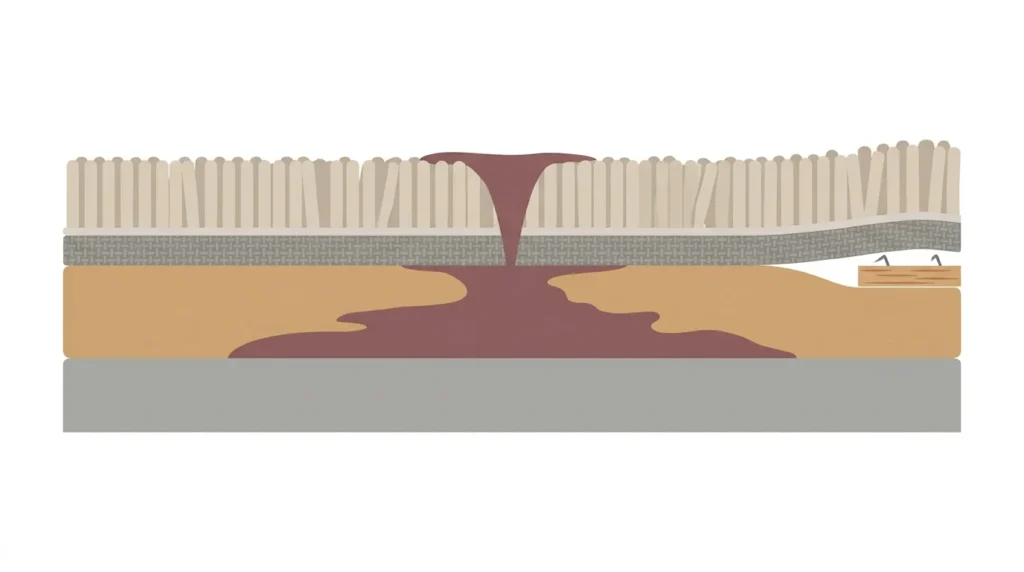
A medium-sized dog can deposit 200 to 400ml in one go. Very little of that stays in the pile.
It passes through the carpet, through the backing, and into the underlay, where it spreads sideways. The patch underneath is routinely two or three times the size of the mark you can see. From there it reaches the gripper rods around the edges of the room, and given enough volume or enough repetition, the floorboards or screed below.
Anything you apply to the surface is treating the smallest part of the problem. That one fact explains almost everything else on this page.
Fresh urine is acidic. Dried urine is alkaline
Fresh pet urine sits around pH 6, mildly acidic. As it dries, bacteria break the urea down into ammonia and the pH climbs to roughly 10 to 12.
That shift is why an accident you missed smells far worse three days later than it did on the day. It’s also when the damage happens, because strongly alkaline conditions can strip or alter the acid dyes used on nylon and wool carpets.
Why the smell keeps coming back
Urine leaves uric acid crystals behind, and those crystals are not water soluble. Wash the area and everything soluble goes, taking the visible stain with it. The crystals stay bonded to the fibre.
Dry, they’re dormant and more or less odourless. Add humidity, a warm day, or the moisture from a carpet cleaning machine, and they wake up and release the smell again.
Which is exactly why so many people find the stain came out, the smell went, and then it returned in June. Nothing went wrong. The crystals were never removed, and only enzymes remove them.
Stain or dye damage? The difference matters
Not every mark is a stain, and the two look identical.
A stain is a substance sitting on or in the fibre. It can come out.
Dye damage is what happens when alkaline urine has sat against the carpet long enough to alter the dye itself. The colour has changed or gone. No cleaner brings it back, because there’s nothing left to remove.
If a mark has been there for months and lightens slightly but never disappears, dye damage is usually why. Working that out early saves a lot of money on products that were never going to help.
Why heat makes it permanent
Never put a steam cleaner or a hot water machine on urine that hasn’t been treated first.
Heat sets protein. It bonds the stain to the fibre and speeds up the bacterial process producing the ammonia smell. Running a hot machine over an untreated urine patch very often leaves you worse off than doing nothing at all.
Cold or cool water only, until the enzymes have finished.
The best carpet cleaners for pet stains
Enzyme cleaners, and why they’re the only category that works
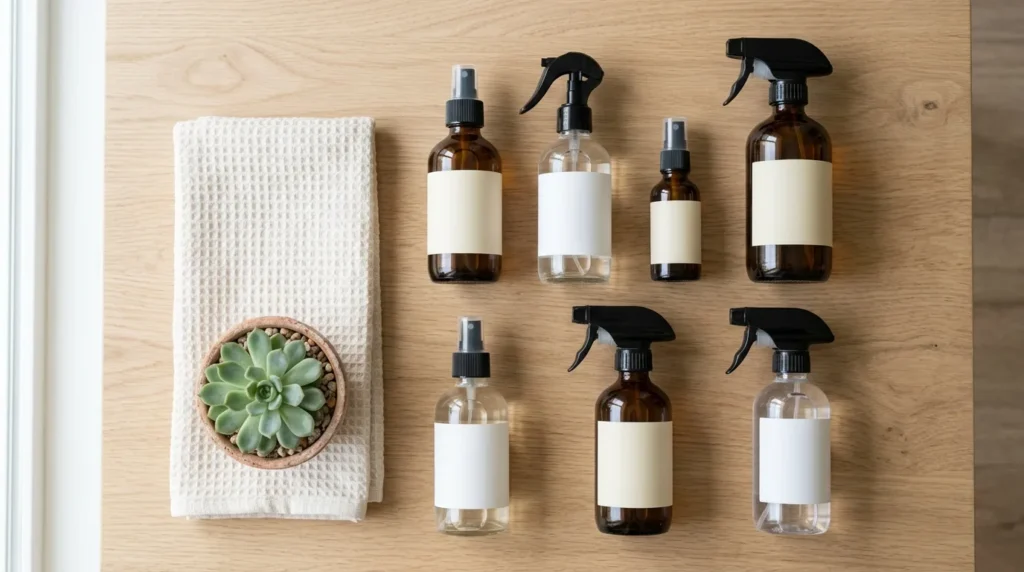
Bio-enzymatic cleaners contain enzymes, usually alongside beneficial bacteria, that consume the organic compounds in urine including the uric acid crystals everything else leaves behind. They don’t mask the smell or wash it away. They digest what causes it.
Nothing else does this. Not carpet shampoo, not general purpose cleaner, not vinegar, and not the “pet formula” products that never say enzymatic anywhere on the label. Read the bottle. If enzymes aren’t mentioned, it isn’t one.
Products worth buying in the UK
| Product | Type | Notes |
| Envii Pet Fresh | Bio-enzymatic | British made, pH neutral, safe around pets and children |
| Urine Off | Bio-enzymatic | Separate dog and cat formulas, the cat version built for higher uric acid content |
| Simple Solution Extreme | Bio-enzymatic | Widely stocked, good value in the larger bottles |
| Rocco & Roxie | Bio-enzymatic | Strong reputation, easy to find online in the UK |
| Dr Beckmann Pet Stain & Odour | Stain remover | Good on the visible mark, weaker on deep odour |
Buy a bigger bottle than feels sensible. Using enough product is the main thing that decides whether an enzyme cleaner works, and a 500ml spray won’t treat a real accident.
Oxidising cleaners, and when they’re appropriate
Commercial oxy-type pet products can lift a discoloured mark that enzymes have deodorised but not visually cleared.
Two conditions. Use them after enzyme treatment and never before, since the oxidiser kills the enzymes. And test a hidden area first, because anything oxidising carries a colour loss risk, particularly on wool.
Spot cleaning machines
A portable spot machine is a genuinely useful thing to own in a house with animals. The Bissell SpotClean range and the Vax SpotWash are the two most common in UK homes.
What they do well is extraction. They pull liquid back out of the carpet in a way manual blotting can’t match, and getting urine out before it dries is worth more than anything you apply afterwards.
Two rules. Cold or cool water, never hot. And use them to extract before you treat, rather than instead of treating.
Hired machines
Rug Doctor and the similar hires from supermarkets and DIY stores will clean a carpet. They won’t resolve pet odour, because they’re built to clean the pile and they don’t extract from the underlay.
Worse, they put a lot of water in. If there are uric acid crystals sitting in the underlay, a hired machine can reactivate them and leave the room smelling stronger than before you started. Treat the urine first. Clean the carpet second.
What to avoid entirely
Anything containing ammonia. Ammonia is a component of urine, so to an animal an ammonia-cleaned patch smells like a toilet. You’ve labelled the spot for reuse.
Bleach. Obvious on colour, and it reacts with the ammonia in urine besides.
Neat hydrogen peroxide. Covered properly below.
Hot water before treatment. Sets the stain.
Air fresheners as the solution. Fine as a stopgap. They do nothing to the source, and scent layered over ammonia usually smells worse than either on its own.
How to use an enzyme cleaner properly
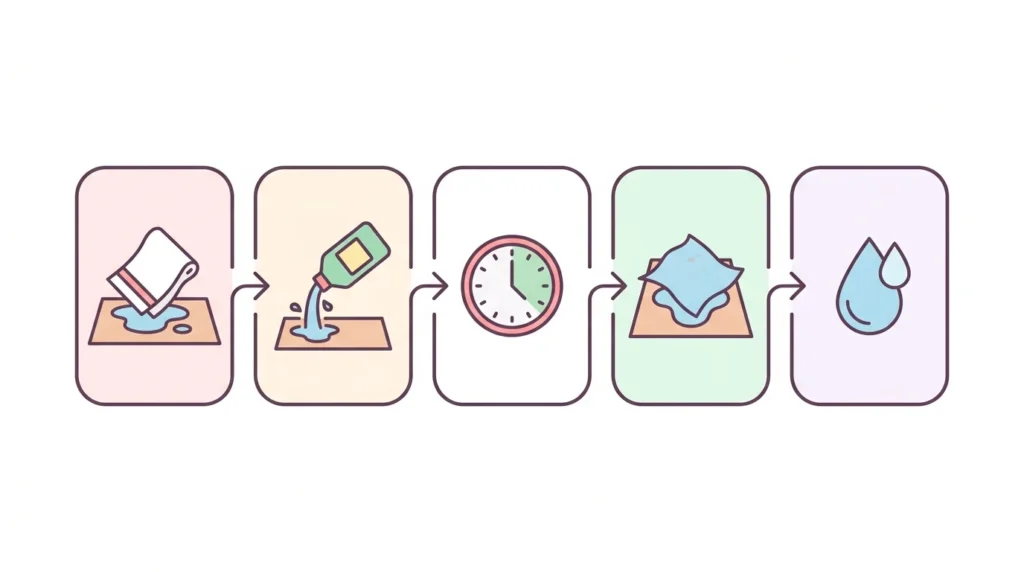
Most people who decide enzyme cleaners don’t work have used them wrongly. There are five steps and four of them get skipped.
1. Blot everything out first
On a fresh accident, get as much liquid up as you physically can before anything else touches it. Thick wads of paper towel or an old towel, pressed hard, standing on it if that’s what it takes. Replace and repeat until the towel comes up nearly dry.
Every millilitre you remove now is one the enzymes don’t have to deal with later.
2. Apply as much as the animal did
The step that matters most. A light spray treats the top few millimetres of pile, and the urine is 20mm further down in the underlay.
To reach the same depth you need roughly the same volume. Pour it on. If the dog deposited 300ml, 300ml of enzyme cleaner is about right, spread wider than the visible mark, because what’s underneath is wider.
It feels wrong. It’s the whole trick.
3. Leave it for hours, not minutes
Enzymes are biological and work at their own pace, which is measured in hours.
Two to four hours minimum, and overnight is better. The instruction on most bottles to blot after ten minutes is optimistic, and following it is the single commonest reason people give up on a product that would have worked.
4. Keep it damp while it works
Enzymes can’t do anything in a dry carpet. If the patch dries out after twenty minutes, the process simply stops.
Lay a damp towel over the treated area, or a sheet of plastic weighted at the corners, to slow evaporation down. Then leave it alone.
5. No hot water at any stage
Not before, not during, not afterwards. Heat denatures the enzymes and stops them working, on top of everything it does to the stain itself.
Once the dwell time is up, blot dry or extract with a spot machine using cool water, then air dry with a window open and a fan running.
Why enzyme cleaners “don’t work” for most people
Three reasons, in order of how often they come up:
- Not enough product. A spray where a pour was needed.
- Not enough time. Ten minutes instead of several hours.
- Something used first that killed the enzymes. Detergent, bleach, an oxidiser or a hot machine.
Fix those three and the same bottle that failed usually works.
Home remedies: what works, what doesn’t, and what causes damage
White vinegar
Limited use, real limits. Vinegar is acidic, so it neutralises some of the alkaline salts in dried urine and can cut the smell noticeably in the short term.
What it can’t do is break down uric acid crystals. Nothing about vinegar touches them. So the odour returns, usually inside a fortnight, and people conclude the stain has come back when it never actually left.
It has a strong smell of its own too, and it can affect dye on wool carpets. Use it as a stopgap on a fresh accident if you’ve nothing else in the house. Don’t build a plan around it.
Bicarbonate of soda
Fine as a dry deodoriser and nothing more. Sprinkled on dry carpet, left for an hour and vacuumed thoroughly, it absorbs some surface odour. That’s a legitimate use and worth doing.
It doesn’t remove urine and it doesn’t touch uric acid. Worked deep into a pile it also becomes very difficult to vacuum back out, and in deep pile the residue can stay gritty for months.
Why mixing vinegar and bicarb does almost nothing
The internet’s favourite carpet remedy, and it’s chemically self-defeating.
Vinegar is an acid. Bicarbonate of soda is a base. Put them together and they neutralise each other, producing carbon dioxide, water and a small amount of sodium acetate. The dramatic fizzing is the reaction using up both ingredients in front of you.
What’s left on the carpet is faintly salty water. Each has a modest use separately. Combined, they cancel out, and you’ve spent two things that might have helped.
Hydrogen peroxide: the one that bleaches your carpet
Recommended everywhere online, and yes, it will lift a urine stain. It lifts it by bleaching, and the bleaching doesn’t politely stop at the edge of the stain.
What you get is a pale patch exactly where the mark used to be, permanently. On a mid or dark carpet that’s more visible than the stain you started with, and there’s no way back.
Commercial oxy-type pet products contain hydrogen peroxide in controlled, stabilised concentrations and are a different proposition used as directed and tested first. Household hydrogen peroxide poured onto carpet is not, and shouldn’t go near it.
Washing-up liquid
It’ll shift a surface mark. It also leaves a residue that attracts soil, so the treated patch gets dirty faster than the carpet around it and turns into a visible darker area within a few months.
If you use it at all, use a tiny amount and rinse thoroughly with cool water.
Old and set-in pet stains
What can still be recovered
The odour, in most cases. Uric acid crystals have no shelf life, so a properly applied enzyme treatment works on a two-year-old deposit much as it does on a two-week-old one, provided the product actually reaches it. Reaching it is the difficult part.
Light discoloration on synthetic carpet usually improves a great deal.
What can’t
Dye damage. Where alkaline urine has altered the colour, cleaning has nothing left to remove. The mark lightens a little as the surrounding soil comes out, then stops.
Wool and nylon are the most vulnerable, because they take acid dyes. Polypropylene is solution-dyed and far more resistant, which is one of the few genuine advantages of a cheap carpet.
Treating urine that has reached the underlay
Surface treatment can’t resolve underlay contamination, however good the product. The enzyme has to reach the contamination, and pouring enough through the carpet to saturate the underlay creates a drying problem of its own.
This is where domestic treatment runs out. Professional pet stain and odour removal uses sub-surface extraction tools that draw contamination up through the carpet from the underlay, which no consumer product or hired machine can do.
When the underlay has to come up
Repeated accidents in one spot, or a single large one left untreated, will eventually contaminate the underlay beyond what extraction can recover.
At that point it’s lifted and replaced, and the subfloor is cleaned and sealed with a specialist odour-blocking sealer before new underlay goes down. It sounds drastic. It’s a fraction of the cost of a new carpet, and once contamination has gone that deep it’s the only thing that resolves it permanently.
Finding urine you can smell but can’t see
Use a UV torch
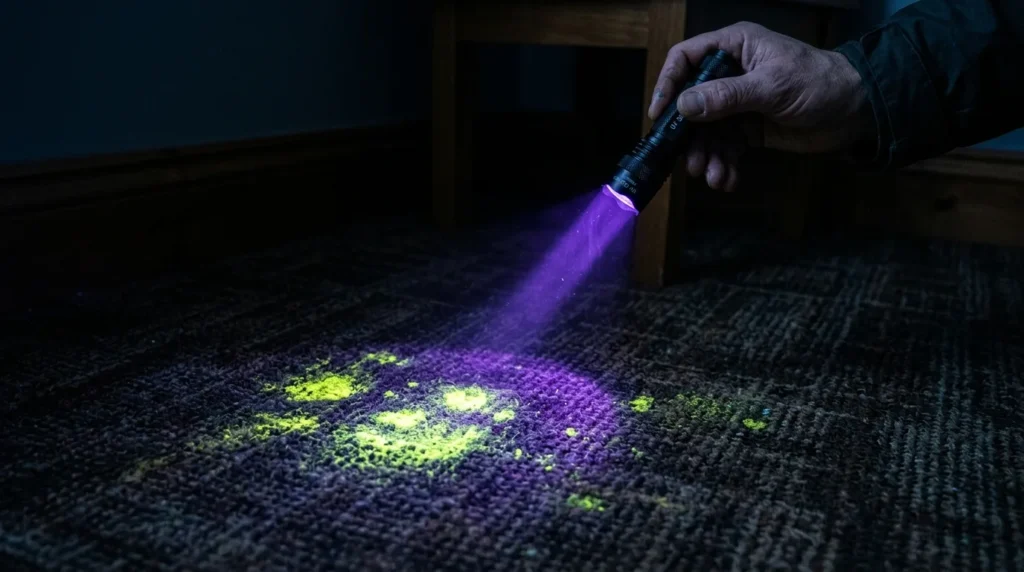
Dried urine fluoresces under ultraviolet light. A UV torch costs a few pounds and finds in five minutes what your nose can only point at vaguely.
Do it at night with the lights off, and give your eyes a minute to adjust. Dried urine shows as a dull yellow-green glow, usually far larger and less defined than you were expecting. Mark each patch with masking tape as you find it, because they vanish the moment the lights go back on.
Where to look first
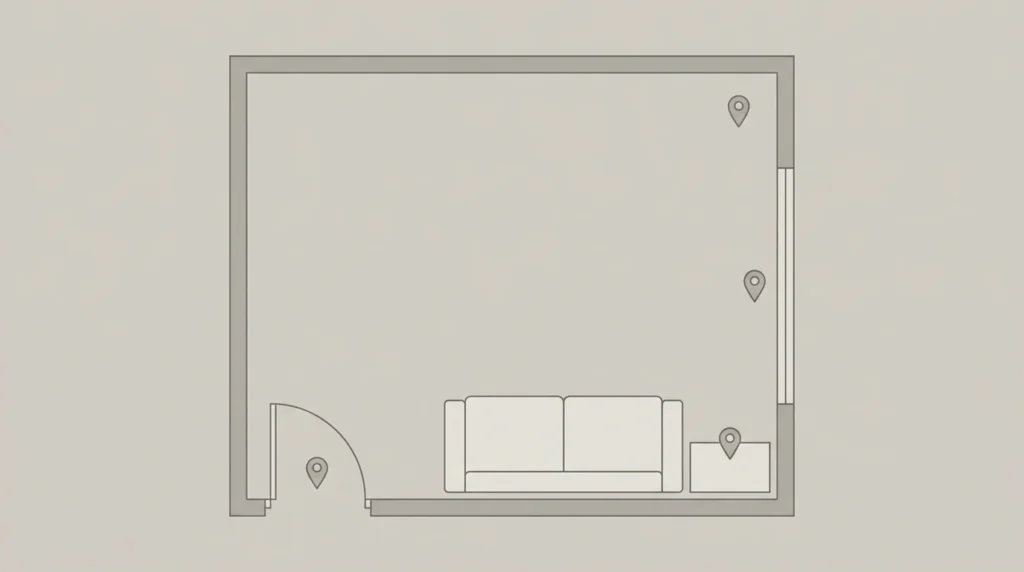
- The edges of the room, along the skirting. Much more common than the middle.
- Doorways and thresholds.
- Corners, particularly behind furniture.
- Low vertical surfaces. Male cats and dogs mark upwards, so check skirting boards, chair legs and the bottom of curtains.
- Around the litter tray, where a cat that dislikes the tray goes nearby rather than in it.
- Under and behind anything that hasn’t moved in a while.
Checking below
If the smell is strong and the surface shows nothing, pull back a corner of the carpet near the affected area where you can do so safely. The gripper rods and the underlay edge will tell you straight away how far it has travelled.
When a professional is the only option
Signs you’ve reached the limit
- The smell returns every time the weather turns humid
- More than one product has already failed
- The affected area is large, or there are several of them
- You can smell it but can’t find it, even with a UV torch
- The carpet has already had a hot machine over it
- Urine has soaked through to the floorboards
What professional treatment involves
Standard hot water extraction cleans the carpet and doesn’t touch what’s underneath it. Pet-specific treatment is a different process.
It normally means saturating the affected area with an enzyme or odour counteractant so it reaches the depth the urine did, allowing proper dwell time, then extracting with a sub-surface tool built to pull liquid up from the underlay rather than off the pile. Severe cases go further, to underlay replacement and sealing the subfloor. A general carpet clean is a separate job from this, and worth booking together.
Ask a cleaner directly whether they use sub-surface extraction for pet contamination. That question separates a real pet treatment from a carpet clean with deodoriser added.
What it costs
Standard carpet cleaning in the UK runs roughly £25 to £45 per room, with most companies applying a minimum charge of £50 to £90. Pet-specific odour treatment is quoted on top, typically £25 to £60 per affected area, depending on size and how deep it has gone.
Underlay replacement is a separate job again, usually a few pounds per square metre plus fitting.
Against several hundred pounds for a new carpet, treatment is worth trying first in nearly every case. If the problem covers several rooms, get both priced and compare properly. It comes up regularly in end of tenancy cleaning too, and for landlords and letting agents turning a property around, where pet damage is a legitimate deduction from a deposit.
Preventing the next accident becoming a permanent one
Act within minutes. The gap between a fresh accident and a dried one is enormous. Blot immediately, treat within the hour, and most accidents leave nothing behind at all.
Keep a kit somewhere you can reach fast: a roll of thick paper towel, a large bottle of enzyme cleaner, two old towels, disposable gloves and a plastic sheet. Hunting through cupboards is how a five-minute job turns into a permanent stain.
Protect the high-risk spots. A washable rug by the back door, in a puppy’s sleeping area, or wherever an older dog settles costs a fraction of treating the carpet underneath.
See a vet if it’s suddenly frequent. A house-trained animal that starts having accidents indoors often has a medical reason. Urinary infections, cystitis, kidney problems, diabetes and age-related incontinence all present this way, and it’s worth ruling out before assuming it’s behavioural.
Pet stains on other surfaces
Rugs. Same enzyme approach, with one advantage: a rug can be treated from both sides and dried properly, flat or outdoors. Wool and hand-knotted rugs need more care, since the dyes are usually less stable and the foundation can be damaged by over-wetting. Those are worth handling as specialist rug cleaning rather than at home.
Sofas and armchairs. Urine goes through the fabric into the foam, which behaves exactly like underlay. Surface cleaning achieves very little, and the fabric’s care code decides what’s safe to use, so check the label before applying anything. A common reason for professional upholstery cleaning.
Mattresses. The worst of the three, because a mattress absorbs deeply, can’t be turned to dry, and holds moisture for a long time. Blot hard, apply enzyme cleaner generously, then dry aggressively with a fan for considerably longer than seems necessary. Cat urine on a mattress is frequently a job for professional mattress cleaning.
If you’ve worked through all of this and the smell is still there, it’s almost certainly below the carpet rather than in it. Get in touch and we’ll tell you honestly whether it can be treated or whether the underlay needs to come up.
Frequently asked questions
What is the best carpet cleaner for pet urine?
A bio-enzymatic cleaner such as Envii Pet Fresh, Urine Off, Simple Solution or Rocco & Roxie. Enzyme products break down the uric acid crystals that cause the recurring smell. Ordinary carpet shampoos remove the visible stain but leave those crystals behind, so the odour returns.
Does vinegar get rid of dog urine smell?
Only temporarily. Vinegar is acidic and neutralises some of the alkaline salts in dried urine, which reduces the smell for a while. It cannot break down uric acid crystals, so the odour usually returns within a couple of weeks. It can also affect the dye on wool carpets.
Why does my carpet still smell of urine after cleaning?
Because the urine went deeper than the cleaning did. Most of an accident passes through the carpet into the underlay, and the uric acid crystals left behind reactivate in warm or humid conditions. Water-based cleaning can even make it worse by remoistening crystals it doesn’t remove.
How long should you leave an enzyme cleaner on carpet?
Two to four hours minimum, and overnight is better. Enzymes are biological and work slowly. The area also has to stay damp throughout, so cover it with a damp towel or plastic sheet. Blotting after ten minutes, as many labels suggest, is the commonest reason these products seem to fail.
Does baking soda remove pet urine smell?
Only at the surface. Sprinkled on dry carpet and vacuumed off within the hour, bicarbonate of soda absorbs some odour. It doesn’t remove urine or break down uric acid, and worked deep into the pile it leaves a gritty residue that is very hard to vacuum out again.
Will a steam cleaner remove pet urine?
No, and it can make the problem permanent. Heat sets protein stains and bonds them to the fibre, so a steam cleaner or hot water machine used on untreated urine locks the stain in. Always treat with an enzyme cleaner first, and use cool water for any extraction.

Leave a Reply