
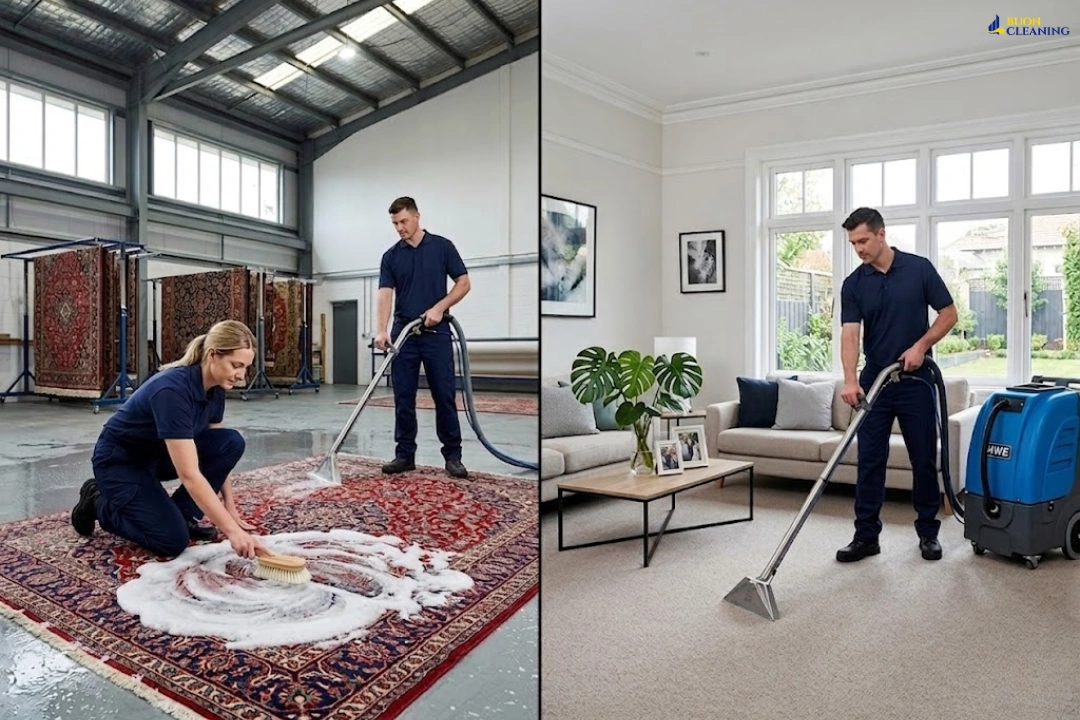
Rug Cleaning vs Carpet Cleaning: The Essential Guide for UK Homeowners
The Quick Answer
Carpet cleaning uses on-site steam extraction for durable synthetic flooring. Rug cleaning is a specialist off-site immersion wash that protects delicate natural fibres wool, silk, cotton from heat damage, dye bleed, and moisture retention.
Table of Contents
Construction Matters: Why Your Rug Is Not a Small Carpet
Most UK homeowners assume a rug is just a smaller carpet. It is not, and that assumption is how expensive rugs get permanently damaged.
Carpet construction is built for durability. Standard UK wall-to-wall carpets use nylon, polyester, or an 80/20 wool-synthetic blend. The fibres are engineered to handle repeated hot water extraction, heavy foot traffic, and industrial cleaning without degrading.
Rug construction is built for craftsmanship. High-end area rugs, Persian, Oriental, Afghan, and Moroccan, are hand-knotted or hand-woven using 100% wool, silk, or cotton. The fibres are natural, the dyes are often vegetable-based, and the structure is fragile under heat and high water pressure. One wrong cleaning method causes irreversible damage.
The weave traps what vacuums cannot reach. Rug construction creates a dense foundation of warp and weft threads beneath the pile. Dry grit, sand, and soil work their way down into this foundation over time. A carpet steam cleaner cleans the surface pile; it cannot extract compacted soil from deep inside the weave structure. That trapped grit acts like sandpaper, cutting fibres from the inside out and causing premature wear long before the rug looks visibly dirty.
On-Site vs. Off-Site: What Actually Works
Carpet Cleaning On-Site
On-site cleaning is the right method for wall-to-wall carpet. A technician brings a truck-mounted or portable hot water extraction unit to your home, cleans the carpet in place, and leaves. It is fast, effective, and appropriate for high-traffic areas, lounges, hallways, and stairs.
It works because synthetic carpet construction handles heat and pressure without damage, and fixed flooring cannot be transported anyway.
Rug Cleaning Off-Site
On-site cleaning is a compromise for area rugs. The correct method is off-site cleaning at a specialist rug laundry because proper rug cleaning requires complete process control that is impossible in your living room.
At a rug laundry, every stage is managed correctly:
- Dry dusting first. Industrial dusting machines beat loose soil, sand, and grit out of the rug’s foundation before any water is introduced. A carpet steamer skips this entirely and wets the dry soil in place, turning it into mud inside the weave.
- Full immersion wash. The rug is submerged in a controlled bath using pH-balanced shampoo matched specifically to the fibre type and dye chemistry.
- Fringe hand-cleaning. Fringe is cleaned separately by hand. On-site machines catch, tangle, and shred fringe without exception.
- Controlled drying. The rug is centrifuge-spun to remove excess water, then dried in a temperature-regulated room. It does not sit damp on your floor for days.
None of this is achievable on-site.
Critical Risks for UK Homes
Hardwood and Laminate Subfloors
Thousands of homes across London, Nottingham, Manchester, and Edinburgh have original hardwood flooring or laminate beneath their area rugs. When a rug is cleaned on-site, water penetrates the backing and sits directly against the floor underneath.
The result is floor warping, watermarks, and, in the UK’s persistently damp climate, black mould growth between the rug backing and the subfloor. This damage is invisible until the rug is lifted. By then, it is permanent.
The “Wet Dog” Smell
The UK’s humidity means a rug that is not properly dried after cleaning will stay damp for days, sometimes weeks. Damp wool produces a persistent sour odour, the well-known “wet dog” smell that does not clear up on its own in a UK interior.
A professional rug laundry uses industrial centrifuges to extract the bulk of moisture immediately after washing, then completes drying in a controlled environment. An on-site clean leaves the rug to air dry in your home, which is rarely sufficient and often makes the smell worse before it gets better.
The Rug Doctor & Rental Machine Warning
Supermarket rental machines, Rug Doctor and similar units are designed exclusively for synthetic carpet. Do not use them on wool, silk, cotton, or any hand-knotted rug.
Two types of damage are common and irreversible:
Fibre bursting. High-pressure extraction forces water through wool fibres faster than they can handle. The fibre walls rupture, the pile blooms outward, and the surface becomes permanently fuzzy and matted. There is no way to reverse this.
Dye migration. Natural and vegetable dyes used in Oriental and Persian rugs are water-soluble. Excess water and agitation cause colours to bleed across the rug: a red border running into an ivory field, a navy medallion bleeding into surrounding cream. This is permanent. No restoration process can fully undo it.
If your rug costs more than £200, a rental machine is not worth the risk. The cleaning cost saved is nothing compared to the replacement cost of a damaged rug.
UK Comparison: At a Glance
| Feature | UK Carpet Cleaning | Professional Rug Cleaning |
| Location | In-home (lounge, stairs) | Specialist rug laundry |
| Typical fibre | Synthetic / 80-20 wool mix | 100% wool, silk, or cotton |
| Construction type | Machine-tufted or woven | Hand-knotted or hand-woven |
| Method | Hot water extraction | Full immersion and dusting |
| Fringes | Not applicable | Manual hand-cleaning |
| Drying | Natural air/air movers | Centrifuge and temperature-controlled room |
| Turnaround | Same day | 5–7 days |
Why Buon Cleaning Does Not Use a One-Size-Fits-All Approach
A single cleaning method applied to every rug causes permanent damage. The fibre type, dye chemistry, weave construction, and backing material all determine how a rug must be cleaned, and no two rugs are identical.
At Buon Cleaning, every rug is assessed before any work begins. The first two checks are always the backing and the weave. The backing determines whether the rug can tolerate full immersion and how long drying will take. The weave determines soil depth, water absorption rate, and the correct shampoo pH.
A rug that has been cleaned incorrectly looks fine immediately after. The damage, fibre distortion, dye bleed, and backing shrinkage appear as it dries. By that point, the process cannot be undone.
FAQs
Is steam cleaning safe for my wool rug?
No. Wool fibres begin to felt and shrink above 40°C. Standard carpet hot water extraction units operate between 60°C and 100°C, well above the threshold for wool damage. Professional rug cleaning uses cool or lukewarm water with pH-neutral solutions formulated specifically for wool. Steam cleaning is safe for synthetic carpet, not for natural-fibre rugs.
Can I clean my rug on top of my carpet?
No. Cleaning a rug in place on top of carpet risks colour transfer in both directions. Loosened dye and cleaning solution from the carpet can wick upward into the rug’s foundation. The rug should always be removed from the room before any cleaning, whether professional or DIY.
How long does professional rug cleaning take in the UK?
Expect 5 to 7 days. The wash itself takes hours. The timeline is determined by drying. Wool and natural-fibre rugs require slow, controlled drying to prevent shrinkage, odour, and backing distortion. Any service promising same-day rug cleaning is cutting corners either on the wash or the drying process.
How often should I have my rug professionally cleaned?
Every 12 to 18 months for rugs in regular use. High-traffic areas, hallways, family rooms, and homes with children or pets may need annual cleaning. Decorative rugs in low-traffic rooms can last up to two years. Do not wait until the rug looks dirty. By then, dry grit has been cutting the fibres from inside the weave for months.
What is the difference between rug cleaning and rug restoration?
Cleaning removes soil, odour, bacteria, and surface contamination. Restoration addresses structural damage, moth damage, torn sections, fringe replacement, re-weaving, or colour correction after dye bleed. Most rugs need cleaning. Only damaged rugs need restoration. A professional will assess and tell you which applies before any work starts.
Can pet urine be fully removed from a wool rug?
Yes, if treated properly. Urine penetrates deep into the foundation and backing, so surface spot-cleaning does not work. The odour returns every time humidity rises because the uric acid crystals remain in the fibres. Full immersion washing with enzyme-based treatment neutralises the crystals at the source. On-site spot treatments mask the smell temporarily. They do not remove it.
Is professional rug cleaning worth it for a cheap rug?
Probably not. If the rug costs between £100 and £150, professional cleaning may cost more than replacement. Professional rug cleaning makes sense for rugs with natural fibres, hand-knotted construction, or real monetary or sentimental value. For inexpensive machine-made synthetic rugs, a rental machine used carefully or straightforward replacement is more practical.
Will professional rug cleaning shrink my rug?
Not if done correctly. Shrinkage happens when wool or cotton rugs are exposed to hot water or aggressive agitation, both of which a professional rug laundry avoids. The risk is real with rental machines and untrained on-site operators who apply carpet cleaning temperatures to natural-fibre rugs. A properly conducted cool-water immersion wash will not cause measurable shrinkage.

Leave a Reply