

Remove Pet Stains and Odours from Carpet: 7 Proven Methods
Six rules apply to every pet stain on carpet: remove solids first, blot rather than rub, work inwards from the edge, use cold water only until you know what the stain is, test on a hidden area, and dry the area faster than feels necessary.
After that, the mess decides the method. Vomit, faeces and blood all set permanently in warm water. Mud runs opposite to everything else and should be left alone until it dries. Getting those two the wrong way round is how a spill becomes a permanent mark.
Table of Contents
The rules that apply to every pet stain
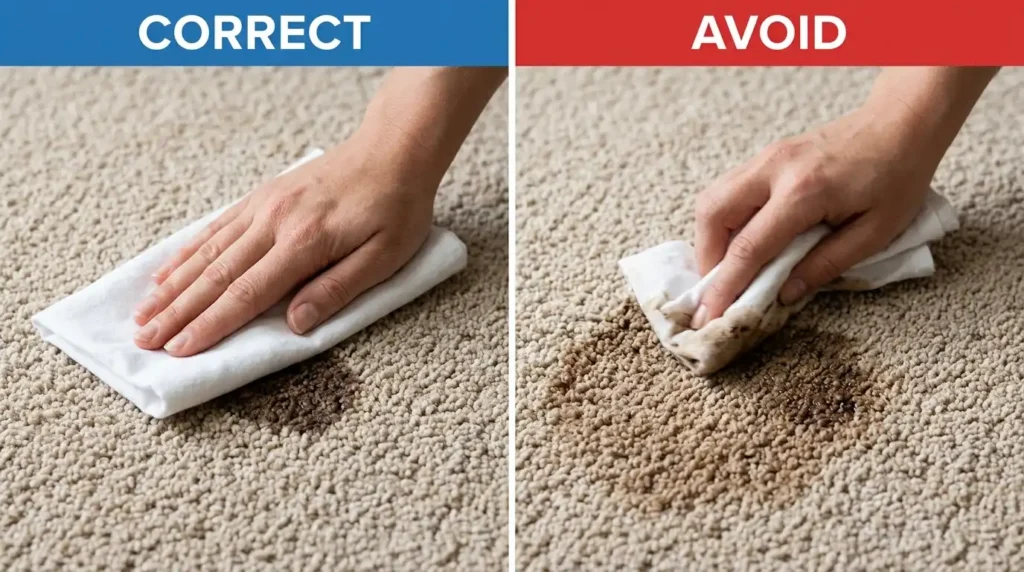
Remove solids before adding any liquid. Water on a solid mess makes a paste, and the paste goes straight into the pile. Lift, scrape or scoop first, every single time.
Blot, never rub. Press a clean cloth down and lift it. Rubbing distorts the pile, drives the stain deeper and spreads it sideways, and a distorted patch stays visible long after the stain itself has gone.
Work inwards from the edge. Start outside the mark and move towards the middle, pulling it together rather than pushing it out.
Cold water only until you know what you’re dealing with. Heat sets protein permanently, and vomit, faeces, blood and urine all contain protein. That covers almost every pet mess there is.
Test on a hidden area. A wardrobe corner, under a sofa, inside a cupboard. Ten seconds with a damp white cloth tells you whether the carpet releases dye.
Dry it faster than seems necessary. Slow drying causes odour, watermarks and stains reappearing from underneath. Windows open, fan on, and stay off the area until it’s genuinely dry.
What you need to hand
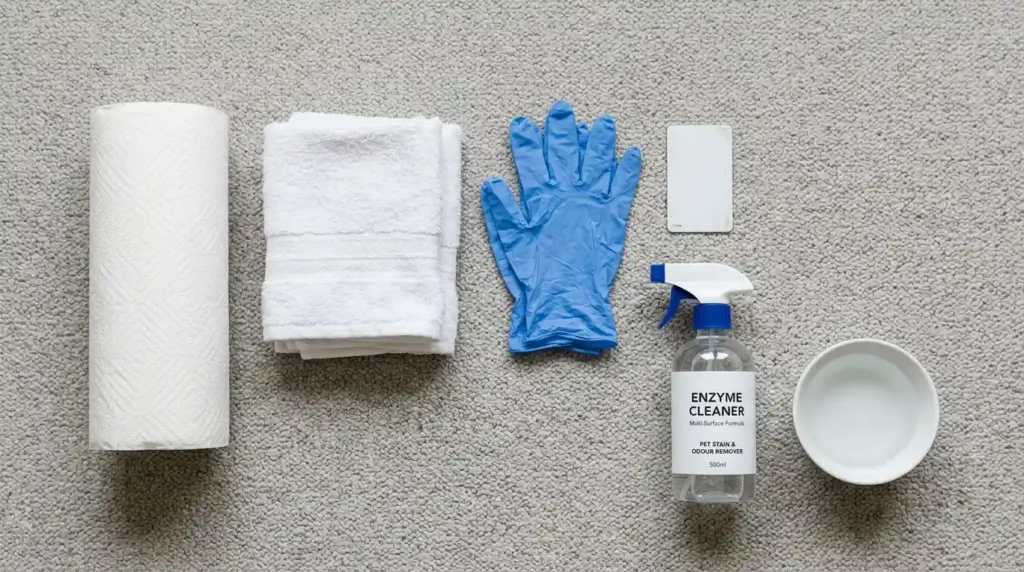
- Thick paper towel, more than you think
- Two or three clean white cloths, never coloured, since coloured cloths transfer dye
- A blunt plastic scraper or an old bank card
- Disposable gloves
- Cool water
- An enzyme-based cleaner
The enzyme cleaner is the only product that really matters for anything biological. If you want the detail on which ones work and why, that sits separately in our guide to pet stain products and what they actually do. For the procedures below, any bio-enzymatic cleaner will do the job.
How to remove each type of pet stain
Urine
- Blot hard with thick paper towel until it comes up nearly dry. Stand on it if that’s what it takes.
- Apply enzyme cleaner generously, roughly matching the volume the animal produced, over an area wider than the visible mark.
- Cover with a damp towel so it can’t dry out, and leave it several hours. Overnight is better.
- Blot dry with cool water, then air dry with a fan.
Urine is the most involved of these, because most of it ends up in the underlay rather than the carpet. That’s why it needs volume and patience rather than scrubbing. If it’s a recurring problem rather than a one-off, the full method for pet urine is worth reading properly.
Faeces
- Don’t touch it while it’s soft. Attacking a soft mess grinds it into the pile and turns a small job into a large one. If it’s very soft, rest a few ice cubes in a bag on top for a couple of minutes to firm it up.
- Lift the solids with a plastic bag over your hand or a blunt scraper, working outside in.
- Scrape the residue off with the edge of a card or a spoon. Still no water.
- Blot with cool water and enzyme cleaner. Faeces is protein and bacteria, so the enzymes do the real work here.
- Repeat until nothing transfers to the cloth, then dry thoroughly.
Two things worth knowing. Never run a vacuum over wet faeces, since you’ll contaminate the machine and spread the problem. And dog faeces can carry roundworm eggs, so wear gloves, bag everything, and wash your hands properly afterwards.
Vomit
The one people underestimate, because it contains stomach acid. Left in place, that acid can strip or alter carpet dye, which makes this time-critical for reasons beyond the smell.
- Remove the solids straight away with a scraper or card.
- Blot the liquid with paper towel, pressing rather than wiping.
- Rinse with cool water and blot again. Warm water sets the protein.
- Treat with enzyme cleaner and give it a couple of hours.
- Dry with airflow.
Bile leaves a yellow tint that sometimes survives enzyme treatment. If it does, that’s the point to consider an oxidising pet product, tested on a hidden area first. On wool, don’t. Oxidisers and wool are a poor combination.
Mud and paw prints
This one runs against every instinct you have.
- Let it dry completely. Hours, not minutes. Wet mud smears, spreads, and pushes deep into the pile, and every attempt to clean it wet makes the area bigger.
- Once it’s bone dry, vacuum thoroughly.
- Break up any remaining crust with a stiff brush, then vacuum again.
- Only now, if a tint remains, treat with cool water and a small amount of mild detergent, blotting rather than rubbing.
Most dried mud comes out at step two. Going at it while wet is the commonest way people turn a paw print into a patch.
Blood
Cold water, always. Warm water coagulates the protein and bonds it to the fibre permanently, and nothing reverses that once it has happened.
- Blot with cold water on a clean white cloth.
- Move to a fresh part of the cloth as it picks up colour, and keep going.
- For anything stubborn, a little washing-up liquid in cold water, used sparingly and rinsed well.
- Enzyme cleaner deals with the residue, since blood is protein.
Older blood responds far less well. The classic internet answer is hydrogen peroxide, and it should stay away from carpet, because it lifts blood by bleaching and leaves a pale patch more obvious than the stain was.
Drool and saliva marks
Dog saliva is alkaline and dries into a stiff, faintly yellow patch, usually at the base of a sofa or wherever the dog rests its head.
Soften it with cool water and blot, then treat with a mild detergent solution and blot again. Enzyme cleaner handles any lingering smell. A straightforward stain, but an easy one to miss until the patch has built up over several months.
Anal gland secretion
Unmistakable if you’ve met it. Strongly fishy, oily, and usually deposited when a dog is startled or drags itself along the carpet.
Because it’s oil-based, water alone spreads it. Blot up everything you can with dry paper towel first, then use an enzyme cleaner or a product formulated for oily pet stains. Ventilate the room heavily and expect the smell to fade over a day or two rather than instantly.
Ground-in pet hair
Once hair has woven itself into the pile, a vacuum won’t touch it.
Put on a rubber washing-up glove, dampen it slightly, and drag your hand across the pile in one direction. The hair balls up and lifts straight out. A rubber squeegee does the same over a larger area, and a carpet rake earns its money if you have a heavy-shedding dog and a lot of floor.
Fresh, dried and old stains
Within the hour. Almost everything is fully recoverable. Blot, treat, dry, and in most cases nothing is left behind at all.
Within a day. Usually recoverable, though it may take two rounds. Odour is more likely to need attention than the visible mark.
Weeks or months old. The odour can generally still be treated, since the compounds causing it have no shelf life. The discoloration is far less certain.
What age makes impossible. Dye damage, where the stain has altered the carpet colour rather than sitting on top of it. It looks identical to a stain, and no cleaning brings it back, because there’s nothing left to remove. A mark that lightens slightly and then stops improving no matter what you throw at it is usually dye damage.
Anything previously treated with hydrogen peroxide or bleach is unrecoverable for the same reason. The fibre itself has changed.
What your carpet is made of changes what you can use
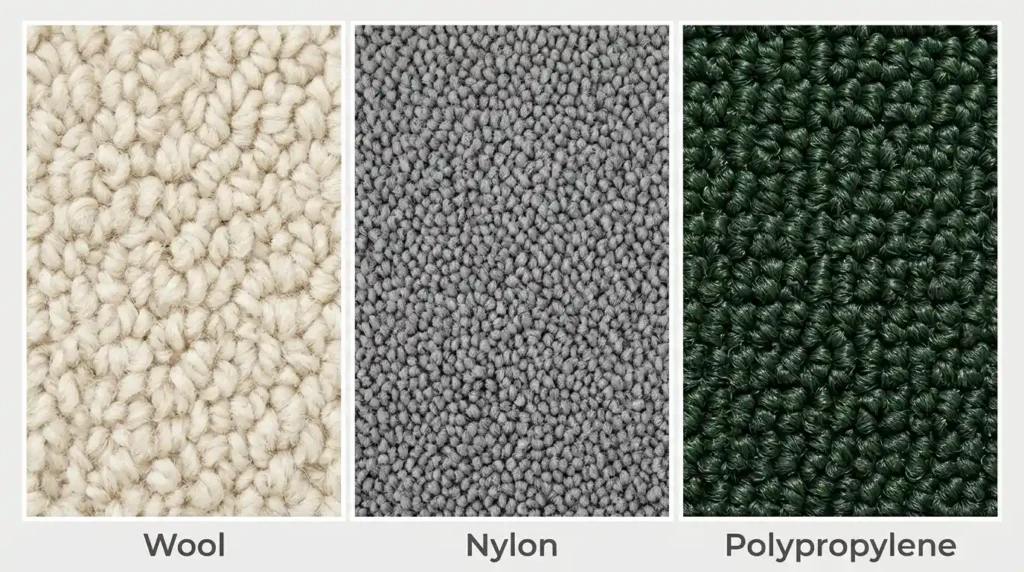
Wool. A natural protein fibre, and the most sensitive thing on your floor. Use pH neutral or slightly acidic products only, because alkaline cleaners cause felting and colour change. Avoid oxidising products entirely. Be careful with enzyme cleaners too, since some enzymes that break down protein stains can also attack the wool itself. Use a wool-safe formulation, test first, and don’t leave it sitting for hours.
Nylon. The most common carpet fibre in UK homes, and generally hard-wearing. It takes acid dyes, which makes it vulnerable to permanent colour change from alkaline urine, but it cleans well otherwise.
Polypropylene. The most forgiving carpet you can own if you have pets. It’s solution dyed, so the colour runs through the fibre rather than sitting on it, and it resists staining and even bleach remarkably well. Its weakness is oil, which it attracts and holds, so greasy marks are the problem rather than water-based ones.
Polyester. Good resistance to water-based stains, poor resistance to oily ones. Treat much as you would nylon.
Sisal, seagrass, jute and coir. These must not get wet. Water causes permanent watermarking, shrinkage and browning, so a wet stain treatment does more visible damage than the stain itself. Blot only, use a dry absorbent powder, and get natural fibre floor coverings handled as specialist rug and natural fibre cleaning rather than tackling them at home.
How to tell what you’ve got. Check the original receipt or any label on the underside. Wool feels soft and springs back when you press it. Polypropylene feels slightly waxy and doesn’t crush the same way. If you genuinely don’t know, treat it as wool, since those are the most restrictive rules and following them won’t harm anything else.
When the stain has gone but the smell hasn’t
Why odour outlives the mark
Because the mark and the smell are usually in different places. What you cleaned was in the carpet. What you can smell is under it.
Liquid passes through the pile and backing into the underlay within seconds, spreading outwards as it goes. The patch below is routinely two or three times the size of the one on top, and surface cleaning never reaches it.
Checking the underlay
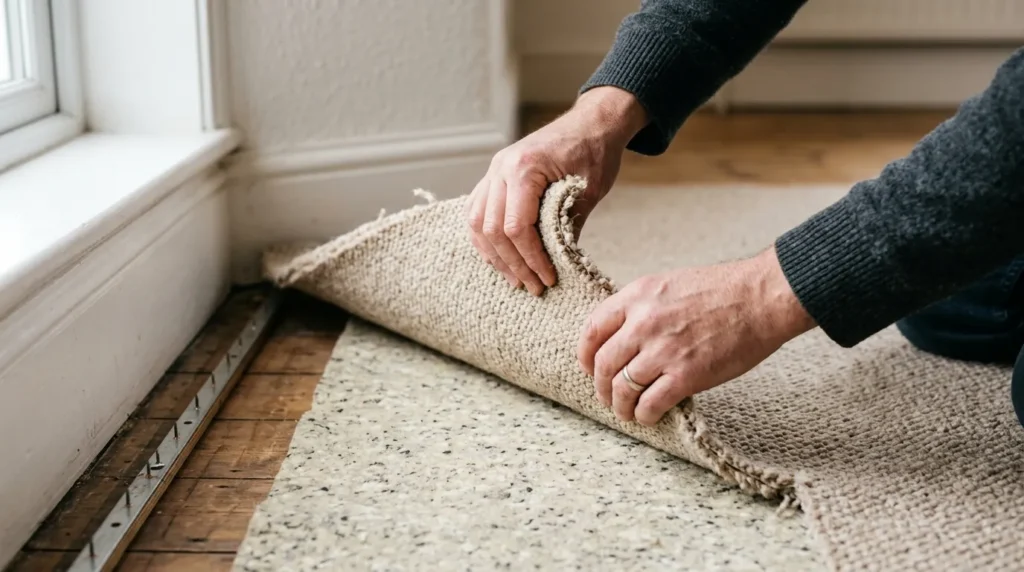
Where it’s safe to do so, ease back a corner of carpet near the affected area and look at the underlay and the gripper rods. Staining there tells you immediately why surface treatment hasn’t worked, and roughly how far it has spread.
If contamination has reached the underlay, that’s the point where professional pet stain and odour removal becomes the practical answer, since sub-surface extraction pulls contamination up from below in a way no domestic method can.
Odour neutralisers against masking sprays
Worth knowing the difference. A neutraliser reacts with or binds the compounds causing the smell, so the smell actually goes. A masking spray adds fragrance on top, wears off within hours, and layered over ammonia usually ends up worse than either was alone.
Read the label. If it talks about fragrance rather than neutralising, it’s the second kind.
When it isn’t the carpet
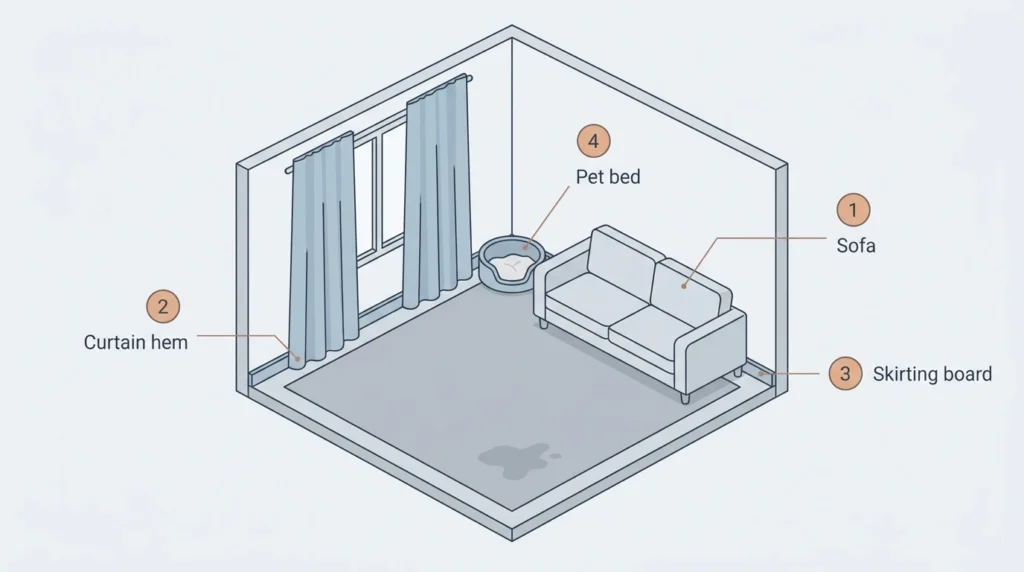
A room that smells of dog frequently isn’t a carpet problem at all.
Skirting boards and gripper rods. Liquid wicks outwards to the edges of a room and soaks into bare timber, which then holds the smell more or less indefinitely. Skirtings are absorbent, almost never cleaned, and the first place to check when the carpet looks fine.
Curtain hems. They sit at floor level, they’re absorbent, and cats in particular mark them. Nobody thinks to smell them.
Beds, cushions and throws. Soft surfaces hold odour far better than hard ones. A dog bed that hasn’t been washed in six months will out-smell every carpet in the house.
Sofas. Fabric furniture absorbs the same things the carpet does and can’t be lifted or aired in the same way, which is a common reason for professional upholstery cleaning. The same goes for any bed a pet sleeps on, where a mattress clean is often the missing piece.
How to work out where it’s coming from. Leave the room for twenty minutes, come back in, and note the very first thing you smell before your nose adjusts. Then get down to nose-to-floor height and work along the skirtings. Both sound undignified and both work considerably better than standing in the middle of the room guessing.
When to stop
Some situations aren’t worth further attempts:
- The smell comes back every time the weather turns warm or humid
- Two or more treatments have already failed
- Several areas are affected, or one large one
- Liquid has reached the floorboards
- The area has already been treated with bleach or hydrogen peroxide
- It’s a natural fibre floor covering and the stain is wet
Professional treatment reaches what home treatment can’t, mainly because the equipment extracts from beneath the carpet rather than off the surface of it. That’s the whole difference, and it’s why some problems resolve in a single visit having resisted six bottles.
Where contamination has gone right through to the subfloor, treatment can mean lifting and replacing the underlay and sealing what’s beneath. It sounds drastic. It’s still a fraction of the cost of a new carpet.
Preventing the next one
Keep a kit where you can reach it in seconds. Paper towel, enzyme cleaner, two old towels, gloves, a plastic scraper. Most permanent stains are simply fresh stains that took twenty minutes to find supplies for.
Protect the high-risk spots. A washable runner by the back door, a rug where an older dog sleeps, a mat under the food bowls. All of them cost far less than treating the carpet underneath.
See a vet if accidents suddenly become frequent. A house-trained animal that starts going indoors, or vomiting repeatedly, often has a medical reason. Urinary infections, cystitis, kidney problems, diabetes and age-related incontinence all present this way, and it’s worth ruling out before treating it as a training issue.
FAQs
How do you get dog vomit out of carpet?
Remove the solids immediately with a scraper, blot the liquid with paper towel, then rinse with cool water and blot again. Never use warm water, which sets the protein. Follow with an enzyme cleaner. Vomit contains stomach acid that can alter carpet dye, so treating it quickly genuinely matters.
How do you clean dog mess off carpet without spreading it?
Let it firm up first, using ice in a bag if it’s very soft. Lift the solids with a plastic bag over your hand, working from the outside in, then scrape the residue with a card. Only add water once all solids are gone, then treat with an enzyme cleaner.
Does hot water set pet stains?
Yes. Heat coagulates protein and bonds it permanently to the carpet fibre, and urine, vomit, faeces and blood all contain protein. Always use cold or cool water on a pet stain, and never run a steam cleaner or hot water machine over one before it has been treated.
Can you use an enzyme cleaner on a wool carpet?
With care. Wool is a protein fibre, and some enzymes that break down protein stains can also attack the wool itself. Use a product specifically stated as wool-safe, test it on a hidden area first, and avoid leaving it in place for extended periods. Keep everything pH neutral.

Leave a Reply