

The three main professional upholstery cleaning methods are hot water extraction, dry solvent cleaning and low moisture or encapsulation cleaning. Which one is safe on your furniture depends on the care code sewn into its label, not on which method sounds most thorough.
Get that pairing wrong and you don’t get a slightly disappointing result. You get watermarks, shrinkage, browning or a permanently flattened pile. Get it right and a sofa you’d written off can come back several shades lighter.
So this starts with the label rather than the machine.
Table of Contents
Start with the fabric, not the method
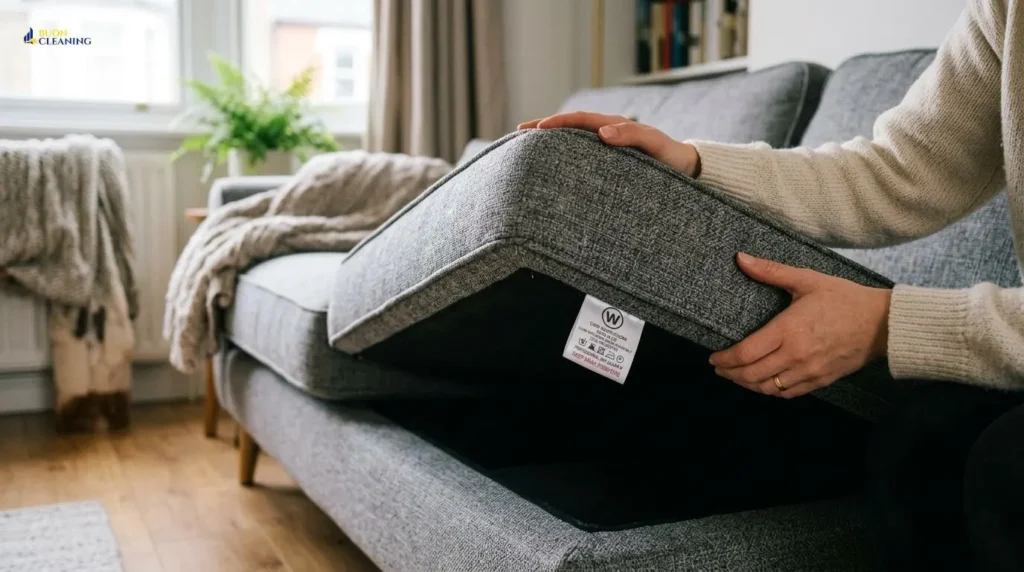
Where to find the care label
Look under the seat cushions first, then along the underside of the frame, then inside the zip of a removable cover. On most UK sofas it’s a small sewn-in tag, usually near the fire safety label required under the Furniture and Furnishings (Fire) (Safety) Regulations 1988.
The fire label is the big permanent one and tells you nothing about cleaning. The care label is smaller, carries a single letter, and tells you everything.
What W, S, WS and X mean
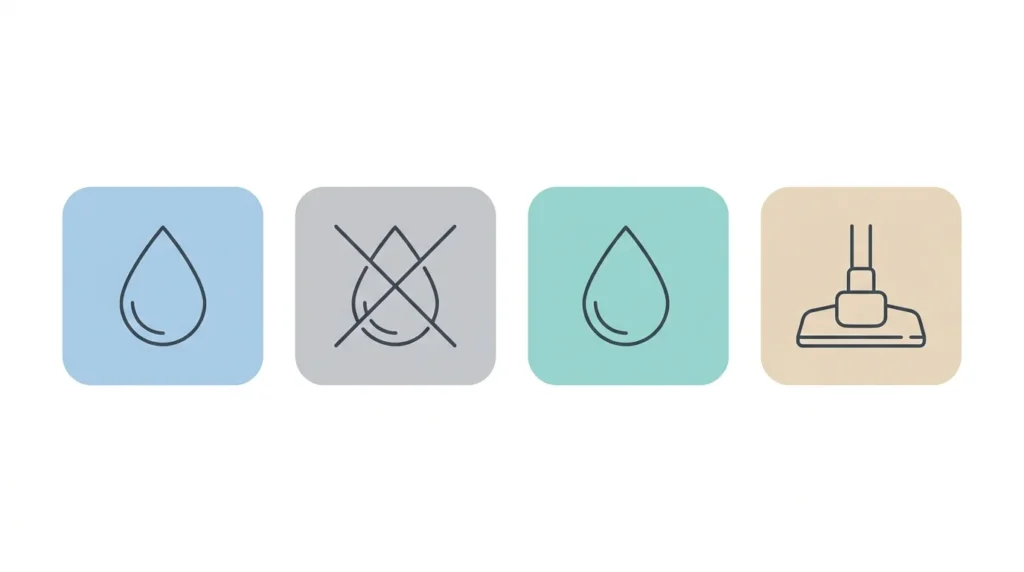
| Code | What it means | What you can use |
| W | Water-based cleaning only | Water-based cleaners, hot water extraction, low moisture |
| S | Solvent cleaning only | Dry solvent products. No water at all |
| WS or W/S | Either is acceptable | Water-based or solvent, whichever suits the soiling |
| X | Vacuum only | No liquid cleaner of any kind. Professional cleaning only |
W is the most common code on modern UK sofas and the most forgiving to work with.
S usually signals a fabric that reacts badly to water. Put water on it and you get rings and stiffening that are very hard to reverse.
X is not a suggestion. These fabrics shrink, distort or watermark on contact with almost anything wet, and a domestic attempt on an X-code sofa nearly always ends in a repair bill.
No label at all, which is common on older and second-hand furniture, means treating it as the most delicate option and testing everything.
The fabrics that need extra care
Viscose and rayon cause more damage than everything else combined. They’re cellulosic, so they lose strength when wet, dry stiff and papery, and yellow or brown around the edges of any damp patch. A great many of the grey linen-look sofas sold across the UK in the past decade contain viscose, and a great many of those are S-code.
Velvet and chenille clean beautifully and then look wrong, because the pile crushes and sets in the wrong direction if it’s over-wetted or dried without grooming.
Linen and cotton shrink and watermark. Dark cottons can also release dye.
Wool wants a neutral or slightly acidic product. Anything strongly alkaline can felt the fibres and shift the colour.
Silk is professional-only in every practical situation.
Test for colour bleed before you start
Take a clean white cloth, dampen it with whatever you plan to use, and press it firmly onto a hidden area for about ten seconds. The back of an arm, under a cushion, behind the skirt.
Any colour on the cloth means the fabric bleeds, and any wet cleaning will move that dye around the sofa. Stop and get advice.
Do this every time, on every piece, even if you cleaned something that looked identical last month. Two sofas that appear the same can behave completely differently.
The main upholstery cleaning methods explained
Upholstery cleaning is the removal of soil, oils, stains and odour from fabric or leather furniture using a method matched to the material, rather than simply wiping the surface. Professional cleaning reaches the soil held deep in the fibres and padding, which surface cleaning leaves behind entirely.
Hot water extraction
The most thorough method available and the standard for most fabric sofas.
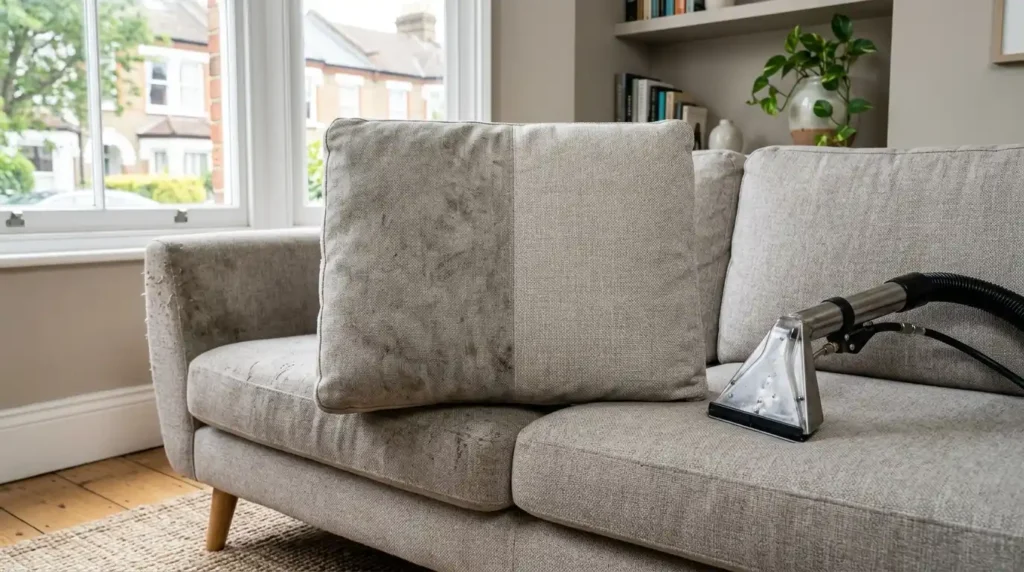
Heated cleaning solution goes into the fabric under pressure and comes straight back out through a powerful vacuum, bringing the dissolved soil with it. A pre-spray usually goes on first to break the soiling down, and a rinse afterwards leaves the fabric at a neutral pH so it doesn’t start attracting dirt again immediately.
Best on W and WS fabrics, cotton, polyester and anything heavily used. Not on S-code, X-code, viscose or silk. Drying is typically two to six hours with decent airflow.
It’s the same principle behind professional carpet cleaning, scaled down to a hand tool with far finer control over how much moisture goes in.
Why “steam cleaning” is usually not steam
This one trips up almost everybody. When people ask for a sofa to be steam cleaned, what they want, and what they nearly always get, is hot water extraction. The water is hot. It isn’t vapour.
Actual steam cleaning uses vapour above 100°C, and on upholstery that brings two problems. It can set protein stains permanently, and it loosens soil without removing any of it, since there’s no extraction, so the dirt simply resettles as the fabric dries. Domestic steam cleaners earn their keep on hard surfaces and grout. They’re a poor choice for deep-cleaning a fabric sofa.
If a cleaner offers steam cleaning, ask whether they mean hot water extraction. Most of them do.
Dry solvent cleaning
A volatile dry solvent goes on, works on the soil, and evaporates. No water goes near the fabric at any point.
This is the method for S-code fabrics, viscose, some velvets and silk. It’s less effective than extraction against heavy general soiling, and it dries in under an hour.
More than anything else, it’s what makes an otherwise uncleanable sofa cleanable, which is why the care code matters as much as it does.
Low moisture and encapsulation cleaning
A cleaning agent is worked into the fabric and crystallises as it dries, forming a shell around each soil particle. Crystals and soil come out together with a vacuum once everything is dry.
Good for light to moderate soiling, delicate fabrics and anywhere that needs to be back in use quickly. Not the answer for anything greasy or genuinely dirty. Drying runs one to two hours.
It’s the usual choice for commercial upholstery cleaning, where a room full of chairs has to be usable by the morning.
Dry foam and shampoo
High-foam product agitated into the fabric and vacuumed out with minimal moisture. An older approach that still suits fabrics unable to take much water.
Residue is the drawback. Foam that isn’t fully removed stays slightly sticky and pulls soil towards it, so the sofa can look worse three months on than it did before anyone touched it.
Absorbent compound cleaning
Slightly damp powder worked into the fibres, left to absorb the soil, then vacuumed away. Almost no moisture involved.
Useful on very delicate items and where drying time needs to be close to zero. Limited against real dirt.
Leather cleaning and conditioning
A different discipline altogether. Leather gets a pH-balanced cleaner and a soft cloth, then a conditioner to replace the oils that cleaning and daily use strip out.
No extraction, no soaking, no household products. Pigmented leather, the most common type on UK sofas, has a protective surface finish and takes careful cleaning well. Aniline and semi-aniline absorb everything, and should only be touched by someone who has identified them correctly first.
Methods compared
| Method | Moisture | Drying time | Cleaning power | Best for |
| Hot water extraction | High, controlled | 2 to 6 hours | Highest | W and WS fabrics, heavy soiling |
| Dry solvent | None | Under 1 hour | Moderate | S-code, viscose, delicates |
| Low moisture / encapsulation | Low | 1 to 2 hours | Moderate | Light soiling, offices, fast turnaround |
| Dry foam | Low | 1 to 3 hours | Moderate | Water-sensitive fabrics |
| Absorbent compound | Minimal | Under 1 hour | Light | Very delicate items |
| Leather clean and condition | None | Immediate | Surface | All leather types |
If you’d rather not work out which of these applies to your sofa, that’s exactly what an assessment before an upholstery clean is for.
Which method suits which fabric
Cotton and linen. Hot water extraction works with care. Both shrink if over-wetted and both watermark, so controlled moisture and quick drying matter more than raw cleaning power.
Polyester, microfibre and Dralon. The most forgiving fabrics in domestic use. Usually W or WS, they take extraction well and dry fast. Their weak point is body oil on arms and headrests, which needs pre-treating separately rather than wiping.
Viscose and rayon. The problem child. Water brings stiffening, yellowing and permanent watermarks, and the damage usually shows up as it dries rather than while you’re working, by which point it’s too late. Solvent cleaning is normally the only safe route.
Velvet and chenille. Cleanable, but the pile has to be groomed in one direction while damp and dried with nothing resting on it. Skip that and you get patches where the nap has set the wrong way.
Wool. Neutral to slightly acidic products, low moisture, gentle agitation.
Leather and faux leather. Clean and condition, never extract. Faux leather cracks if it dries out or meets anything solvent-based.
By item
Sofas and armchairs hold the most body oil on arms and headrests. That needs pre-treating on its own, or those areas stay dark while everything around them lightens.
Dining chairs collect food and grease on the seat and very little elsewhere. Quick work, usually priced per chair.
Headboards get overlooked constantly and pick up hair oil and skin cells at much the same rate as the mattress they lean against. Worth doing alongside mattress cleaning rather than as a job on its own.
Office chairs take heavy contact time across a small area, and mesh and fabric backs hold more than anyone expects.
Curtains and blinds are the other thing in the room carrying the same soil and odour as the sofa. When a room smells, the curtains are usually part of the reason.
How to clean upholstery at home
Perfectly doable on W and WS fabrics with light to moderate soiling. Four steps, in order, and the first matters more than the other three.
What you need
A vacuum with an upholstery tool and a crevice tool. Clean white cloths or microfibres, never coloured ones, since coloured cloths transfer dye. A water-based upholstery cleaner suited to your fabric code. A small soft brush. A fan or an open window.
Step one: vacuum properly
Most of what makes a sofa look grey is dry soil, and dry soil comes out with a vacuum. Add liquid before you’ve removed it and you’ve made mud, which you then push deeper into the fibres.
Cushions off. Crevices, back, sides, skirt. Spend longer on this than feels reasonable. It accounts for a large share of the visible improvement and it’s the step everybody skips.
Step two: test in a hidden area
Care code checked, colour bleed test done, as above. Let the test patch dry completely before going further, because watermarking and stiffening appear on drying rather than on contact.
Step three: clean in sections
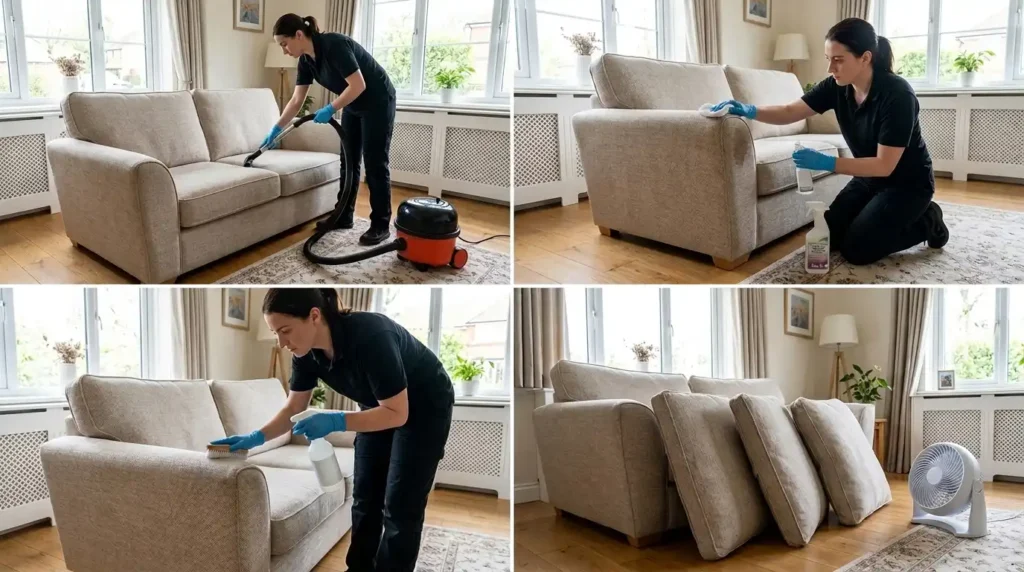
Work one panel at a time. One cushion, one arm, one back section.
Apply the cleaner as a light mist rather than a soaking, agitate gently with a soft brush in a single direction, then blot with a clean white cloth. Blot, don’t rub. Rubbing distorts the fibres and drives soil further in. Work from the outside of a mark inwards so you aren’t spreading it.
The commonest mistake here is using too much product. If the fabric feels wet rather than damp, you’ve overdone it, and you’ll get a ring where the damp area stops.
Step four: dry it fast
Fast drying isn’t a finishing touch. It’s what prevents most of what goes wrong. Slow drying brings odour, watermarks and stains reappearing.
Open the windows, point a fan at it, stand the cushions on edge so air moves round all sides. Don’t sit on it until it’s completely dry, which usually means two to six hours and longer in a cold or damp room.
What not to use
Too much water. The single biggest cause of home cleaning damage, by a wide margin.
Washing-up liquid in any quantity. It cleans, then leaves a residue that holds onto soil, so the sofa gets dirty again noticeably faster than it did before.
Bicarbonate of soda worked into the fabric. Sprinkled on and vacuumed off within the hour it’s a decent dry deodoriser. Worked in or left overnight, the residue is very difficult to recover from foam and it stays gritty.
Undiluted white vinegar. It has its uses, but it’s acidic and it affects some dyes. Never on wool or silk without knowing exactly what you’re doing.
Bleach, or anything containing it. On any upholstery, ever.
Hot water on an unidentified stain. Heat sets protein permanently. If you don’t know what it is, use cold.
Supermarket cleaners and hired machines
Aerosol and spray upholstery cleaners are fine for spot treatment and light refreshing. They won’t deep clean a family sofa, and using more of the product doesn’t change that.
Hired carpet machines with an upholstery hand tool will clean, but their vacuum recovery is far weaker than professional equipment, so much more water goes in than comes back out. That’s exactly the condition that causes wicking, slow drying and odour. If you use one, use half the solution you think you need and dry the sofa aggressively afterwards.
Upholstery stain removal
Six rules that apply to every stain
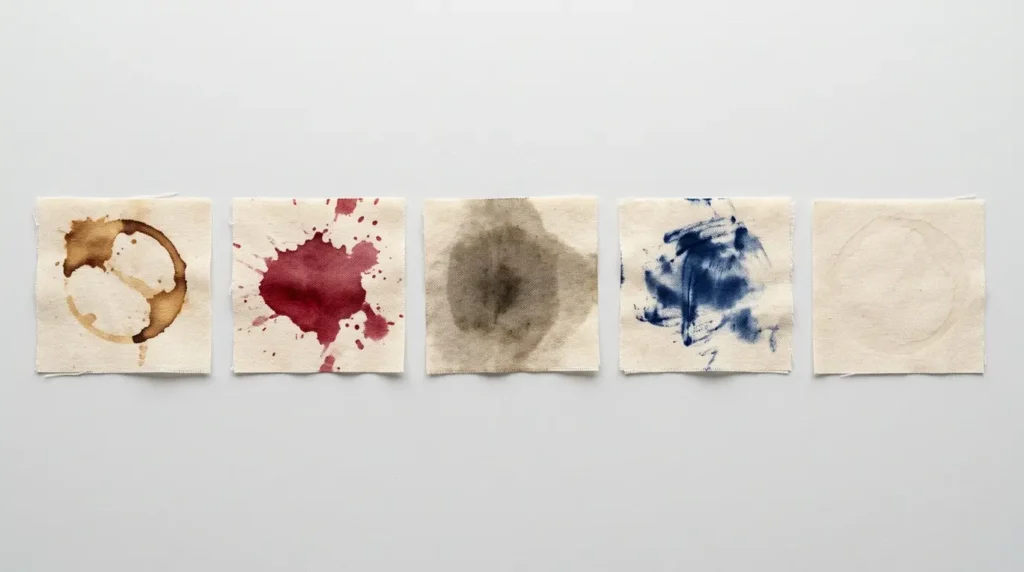
- Act fast. A fresh spill is a job. A dried one is a problem.
- Blot, never rub. Press a clean white cloth down and lift. Move to a fresh part of the cloth and repeat.
- Work inwards from the edge, so the mark doesn’t spread into clean fabric.
- Use as little liquid as possible. More liquid, bigger ring.
- Cold water until you know what it is. Heat sets proteins and some dyes permanently.
- Test first, even in an emergency. Ten seconds on a hidden area.
Tea, coffee and red wine
Tannin stains. Blot up everything you can immediately, then work with cool water and a small amount of a suitable upholstery cleaner, blotting between each application.
Never hot water, and never soap flakes or washing-up liquid as a first response, since both can set the tannin. Red wine on a light fabric is one to treat as genuinely urgent, and one where calling someone early is worth far more than calling them next week.
Grease, oil and food
Water alone spreads grease rather than lifting it. Lift solids off with a blunt edge first, then blot with a dry cloth.
On S-code fabric or a heavy greasy mark, a solvent product does the work. On W-code fabric, a little absorbent powder left to draw the oil out and then vacuumed away often beats any liquid.
Ink and biro
High risk, and the point where most home attempts make things considerably worse, because ink spreads fast and a small mark becomes a large grey smudge.
If you’re going to try, dab with a solvent product on a cotton bud, working outside in, changing the bud constantly. No rubbing, and stop the second it starts to spread.
Pet accidents and odour
Surface cleaning does almost nothing for pet urine, because the liquid soaks through the fabric into the foam and webbing underneath. Clean the top and the salts stay put below, which is why the smell comes back on the first humid day.
Proper treatment means an enzyme product applied so it reaches the depth the urine reached, given time to work, then extracted. That’s what pet stain and odour removal is for, and it’s a different job from a routine clean.
Blood
Cold water, always. Warm water coagulates the protein and sets the stain permanently.
Blot with cold water and a clean cloth, repeatedly, changing cloths as they pick up colour. Patience achieves more here than any product will.
Old and unknown marks
Be realistic about these. A mark that’s been there two years has usually bonded to the fibre, or has already caused a colour change beneath it, and no amount of cleaning brings back dye that has gone.
Old marks are also where testing matters most, because you don’t know what was previously used on them. Somebody has usually already tried something.
Why stains come back after cleaning
This is wicking, and it’s the most common complaint after any upholstery clean anywhere.
As the fabric dries, moisture travels upward through the padding and carries dissolved residue from old spills back to the surface with it. The mark you removed reappears a day later, slightly larger and slightly fainter.
It happens because the original spill went deeper than the cleaning did. The fix is more extraction and much faster drying, and on a sofa prone to it, a second pass once dry usually finishes the job.
Browning is its cousin. Natural fibres and jute webbing release tannins when wet, which travel to the surface and leave a yellow-brown cast, generally around the edges of a cleaned area. Most common on cotton, linen and older frames, and one of the clearest reasons controlled moisture beats maximum moisture.
When to stop and call a professional
Some situations aren’t worth attempting at all:
- X-code, or no label. There’s no safe way to test your way in.
- Viscose, silk, or anything you can’t identify. The damage appears on drying and can’t be undone.
- Colour that transfers to the test cloth.
- Ink, dye transfer, or anything already treated by someone else.
- Pet odour, which has to be treated at depth or it returns.
- A sofa that’s genuinely dirty rather than marked. Even soiling across a whole piece needs extraction, not spot cleaning.
Professional equipment does two things domestic kit can’t. It heats the solution to a controlled temperature that dissolves soil far more effectively, and its vacuum recovery pulls most of the moisture back out, leaving the fabric damp rather than wet when the job finishes. That recovery is the whole difference, because it’s what prevents wicking, browning and long drying times.
If the sofa matters and you aren’t sure what it’s made of, talk to someone before putting anything on it.
What professional upholstery cleaning costs in the UK
| Item | Typical UK price |
| Dining chair | £8 to £15 each |
| Armchair | £25 to £45 |
| Two-seater sofa | £40 to £60 |
| Three-seater sofa | £60 to £100 |
| Corner or L-shaped sofa | £90 to £150 |
| Per seat, where charged that way | £15 to £25 |
Minimum charges of £50 to £100 including VAT are normal, and worth understanding rather than resenting. Whether a cleaner treats one armchair or a full suite, the travel, setup and equipment cost barely changes, so a single small item rarely covers it. That’s why booking the sofa, the chairs and any rugs together is far better value than doing them one at a time.
Usually extra: fabric protector, enzyme treatment for pet odour, deodorising, and stain work beyond a routine clean. Ask what’s included before booking rather than afterwards.
If you’re clearing a whole property rather than treating one item, upholstery is normally quoted alongside carpets as part of end of tenancy cleaning.
How to choose an upholstery cleaning service
Five questions worth asking:
- Which method will you use on my fabric, and why that one?
- Will you check the care label and test before starting?
- How long will it take to dry?
- What’s included, and what would be extra?
- Are you insured?
The first tells you the most. Anyone who names a method before seeing the sofa is describing the only machine they own rather than assessing your furniture.
Certification and insurance. Public liability insurance is the minimum. Membership of a recognised trade body such as the National Carpet Cleaners Association suggests someone has been trained rather than merely equipped.
A proper quote names the items, the price for each, whether VAT is included, and what happens if a stain doesn’t come out.
Warning signs: promising every stain will come out before seeing the sofa, no mention of testing, no drying time offered, and pressure to book on the spot. Nobody honest guarantees the removal of a stain they haven’t looked at.
There’s more on how we work on our about page and in our FAQs.
Keeping upholstery clean between cleans
How often to deep clean. Every 12 to 18 months for a family sofa in daily use. Every 6 to 12 months with pets, smokers or allergy sufferers in the house. Every two years or so for lightly used furniture in a spare room.
Weekly. Vacuum it properly, under and behind the cushions included. This is the single most effective thing you can do, because taking dry soil out before it gets ground in prevents most of the wear that makes fabric look old.
Monthly. Rotate and turn the cushions so wear spreads evenly, and deal with marks while they’re still fresh.
Fabric protector is worth considering on new furniture, pale fabrics, and any house with children or pets. It doesn’t make a sofa stain-proof. What it does is slow absorption, buying you the minute or two needed to blot a spill before it reaches the fibre, and that minute is usually the difference between a wipe and a stain. It wears off with use, particularly on arms and seats, so it wants reapplying after a deep clean rather than lasting forever.
If your sofa is past the point where any of this helps, get in touch and we’ll tell you honestly what can and can’t be brought back.
Frequently asked questions
What is upholstery cleaning?
Upholstery cleaning is the removal of soil, body oils, stains and odour from fabric or leather furniture using a method matched to the material. Professional cleaning reaches soil held deep within the fibres and padding, which surface wiping and vacuuming leave behind.
What techniques do upholstery cleaning services use?
The three main techniques are hot water extraction, dry solvent cleaning and low moisture or encapsulation cleaning. Dry foam, absorbent compound and leather conditioning cover more specialist cases. Which one is used depends on the fabric’s care code, the type of soiling and how quickly the item needs to be usable.
What should I look for in an upholstery cleaning service?
Look for public liability insurance, a willingness to check the care label and test before starting, a written quote listing each item and whether VAT is included, and a realistic drying time. Anyone naming a cleaning method before seeing your sofa is describing their equipment rather than assessing your furniture.
What are the best spot-cleaning methods for upholstery and stain removal?
Blot rather than rub, work inwards from the edge of the mark, use the least liquid you can, and stay with cold water until you know what the stain is. Test any product on a hidden area first. Tannin stains need cool water, protein stains need cold, and grease needs solvent or absorbent powder.
How often should you clean upholstered furniture?
Deep clean a family sofa every 12 to 18 months, or every 6 to 12 months with pets, smokers or allergy sufferers in the house. Lightly used furniture can go two years. Weekly vacuuming between deep cleans does more for how a sofa ages than anything else.

Leave a Reply